

Who this is for: Best for TV shoppers comparing display tech and wanting the clearest 2026 buying choice for bright rooms, movies, sports, or gaming.
Check PriceWhat is mini led vs oled vs qled 2026? A Complete 2026 Guide
If you’re trying to choose between Mini LED, OLED, and QLED in 2026, the specs can feel confusing fast. The good news is that each display type solves a different problem: brightness, black levels, color, or value. This guide breaks down how they work, where each one shines, and which TV style makes the most sense for your room and viewing habits.
Related Reviews
How It Works
Mini LED, OLED, and QLED all aim to improve picture quality, but they do it in very different ways.
OLED uses self-emissive pixels, which means each pixel creates its own light. Because pixels can turn completely off, OLED is known for deep blacks, excellent contrast, and strong viewing angles. That’s why it often looks especially impressive in dark rooms and for movies with a lot of shadow detail.
QLED is a type of LCD TV that uses a quantum dot layer to improve color and brightness. It still needs a backlight, so it cannot match OLED’s perfect black levels pixel-for-pixel, but it usually gets brighter and can handle well-lit rooms very well. QLED is often chosen by buyers who want vivid color and a brighter image without paying OLED-level prices.
Mini LED is also an LCD-based approach, but it uses much smaller LEDs in the backlight and more precise local dimming zones. That gives it better contrast control than standard LED or many basic QLED sets, while still keeping the brightness advantage of LCD technology. In 2026, many Mini LED TVs also add quantum dots, which is why you’ll often see “QLED Mini LED” or “QD-Mini LED” in product names.
In simple terms: OLED is best for pixel-level black control, QLED is best for bright and colorful LCD performance, and Mini LED tries to narrow the gap by making LCD contrast much more precise.
Key Benefits & Use Cases
OLED: Best for movie lovers and dark-room viewing
OLED is usually the pick for people who care most about cinematic contrast. If you watch a lot of films at night, want near-perfect blacks, and value wide viewing angles, OLED remains the benchmark. It is also a strong fit for viewers who sit off-center from the screen.
QLED: Best for bright rooms and color-rich content
QLED is a practical choice for living rooms with lots of daylight. It tends to look punchy, vivid, and easy to see in bright environments. Sports, streaming, and general TV watching all benefit from the extra brightness and strong color volume.
Mini LED: Best all-rounder for mixed use
Mini LED is often the sweet spot for buyers who want strong brightness plus better contrast than standard LCD. It’s especially appealing for sports, gaming, and mixed household viewing where the TV needs to perform well in both bright and dim conditions. In 2026, Mini LED models are increasingly positioned as the “premium without going OLED” option.
Where each technology fits best
- Movies and streaming in a dark room: OLED
- Bright family rooms and daytime viewing: QLED or Mini LED
- Gaming and sports with high motion clarity: Mini LED or QLED
- Best contrast without choosing OLED: Mini LED
- Best value for a brighter TV experience: QLED or Mini LED
What to Look For When Buying
1) Room brightness
If your room gets a lot of sunlight, prioritize brightness. QLED and Mini LED usually handle glare better than OLED. For darker rooms, OLED’s black levels can be more rewarding.
2) Contrast and black levels
Contrast is the biggest reason people choose OLED. If you want the deepest blacks and the cleanest shadow detail, OLED is still the reference point. Mini LED is the strongest LCD-based alternative because local dimming helps dark scenes look much better than standard LED TVs.
3) Motion handling
Sports fans and gamers should pay attention to refresh rate and motion processing. Many modern Mini LED TVs, including the TCL models below, advertise high refresh rates that help fast action look smoother. That matters when you’re watching live sports or playing fast-paced games.
4) HDR support
HDR formats such as Dolby Vision, HDR10, HDR10+, and HLG can improve highlight detail and overall image impact. A TV with strong HDR support can make a bigger difference than many buyers expect, especially when paired with a bright panel.
5) Screen size and seating distance
Technology matters, but so does size. A larger screen can make a bigger difference to immersion than a small jump in panel quality. Choose the display type that fits your room, then pick a size that matches your seating distance and viewing habits.
Top Recommended Products
Below are the best matching products from the current list for readers comparing Mini LED-style options in 2026. Since this is a research-based explainer, these recommendations are based on published specs, feature sets, and owner feedback patterns rather than hands-on testing.
 TCL 75 Inch QM8L Series SQD-Mini LED QLED 4K Smart Google TV 75QM8L (2026)


This is the flagship-style pick in the list and the most aggressive Mini LED option here. Its standout strengths are the very high brightness, dense dimming-zone approach, and advanced color processing, all of which are exactly what many shoppers want when comparing Mini LED vs OLED vs QLED in 2026. If you want a premium big-screen experience without moving into OLED territory, this is the strongest overall match.
- ✓ Up to 4000+ discrete dimming zones for more precise contrast control
- ✓ Up to 6,000 peak nits for very strong brightness
- ✓ Ultra Color Filter for improved color accuracy
- ✓ 144Hz support for smoother motion in sports and gaming
- ✓ AI-powered picture and sound features for a more polished experience
TCL 65 Inch QM6K Series QLED Mini LED 4K HDR Smart Google TV, 65QM6K


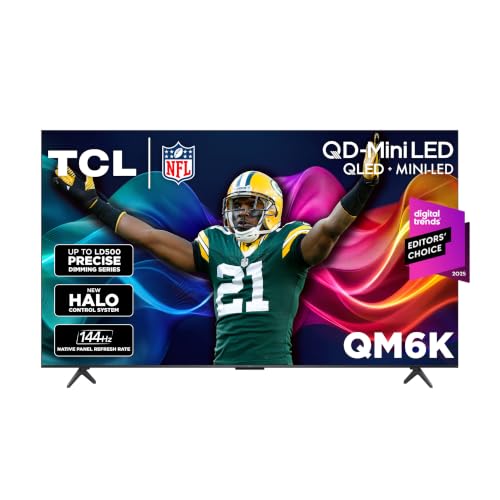
This model is a strong middle-ground choice for buyers who want Mini LED benefits without jumping to the premium tier. It combines high brightness, quantum dot color, and advanced local dimming, which makes it especially relevant for shoppers who want a more versatile alternative to standard QLED. It also makes sense for gaming and sports thanks to the 144Hz panel and motion-focused features.
- ✓ QD-Mini LED design for brighter highlights and richer color
- ✓ Halo Control System aimed at reducing blooming and improving shadow detail
- ✓ Dolby Vision, HDR10+, HDR10, and HLG support
- ✓ 144Hz native refresh rate for smoother fast action
- ✓ Good fit for mixed use: streaming, sports, and gaming
TCL 55 Inch QM6K Series QLED Mini LED 4K HDR Smart Google TV, 55QM6K

This is the same Mini LED concept in a more compact size, which makes it a smart fit for smaller living rooms, bedrooms, or apartments. It keeps the same core selling points as the larger QM6K model: bright picture, quantum dot color, local dimming, and high refresh rate support. If you want a practical entry point into Mini LED without going too large, this is the easiest recommendation.
- ✓ Compact size for smaller spaces
- ✓ Mini LED plus QLED color for strong all-around picture quality
- ✓ High brightness for daytime viewing
- ✓ 144Hz support for gaming and sports
- ✓ Good balance of features for the category
 TCL 50 Inch QM6K Series QLED Mini LED 4K HDR Smart Google TV, 50QM6K

This is the budget-friendly option in the group and a sensible way to get Mini LED features at a smaller size. It still aims to deliver the same basic formula: better contrast than standard LCD, bright performance, and a feature set suited to gaming and streaming. For shoppers comparing value across Mini LED vs OLED vs QLED 2026, this is the most approachable entry point on the list.
- ✓ Budget-tier entry into Mini LED
- ✓ Good choice for smaller rooms
- ✓ Halo Control System for improved black handling
- ✓ Retains the core QM6K feature set
- ✓ Better value positioning than premium models
Common Mistakes to Avoid
Choosing based on one spec only
It’s easy to overfocus on contrast, brightness, or color and ignore the rest of the picture. A TV that looks great in one category may disappoint in another. The best choice depends on your room, seating, and how you actually watch content.
Buying OLED for a very bright room without considering glare
OLED can look incredible, but it is not always the easiest match for sunlit spaces. If your room is bright most of the day, a strong Mini LED or QLED model may be more practical.
Assuming all QLED TVs are the same
QLED is only part of the story. Backlight quality, local dimming, processing, and panel tuning can change the experience a lot. A well-tuned Mini LED TV can outperform a basic QLED set by a meaningful margin.
Ignoring refresh rate for sports and gaming
If you watch live sports or play fast games, motion performance matters. A higher refresh-rate panel can make fast movement look cleaner and more responsive.
Overbuying size or undersizing the screen
Screen size should fit your room and seating distance. A smaller TV with the “right” technology can be less satisfying than a larger TV that matches your space better.
Frequently Asked Questions
Is Mini LED better than OLED in 2026?
It depends on what you value most. OLED is usually better for black levels and cinematic contrast, while Mini LED is often better for brightness and daytime viewing. Mini LED can be the better all-rounder for mixed-use rooms.
Is QLED the same as Mini LED?
No. QLED refers to quantum dot color enhancement, while Mini LED refers to the backlight technology. Many TVs combine both, which is why some models are marketed as QLED Mini LED.
Which is best for bright rooms: Mini LED, OLED, or QLED?
Mini LED and QLED are usually the stronger choices for bright rooms because they can get brighter and handle glare better. OLED can still look great, but it is generally more at home in darker viewing environments.
Why do some TVs say QD-Mini LED?
That means the TV uses Mini LED backlighting plus quantum dot color technology. The goal is to combine the brightness and contrast benefits of Mini LED with the richer color of QLED-style quantum dots.
What should I buy if I want the best value in mini led vs oled vs qled 2026?
If you want strong picture quality without going all the way to OLED pricing or design priorities, Mini LED is often the best value. In this list, the TCL QM6K models are the most approachable way to get that balance.
Pros
- + Mini LED offers strong brightness and better contrast than standard LCD
- + OLED delivers the deepest blacks and excellent viewing angles
- + QLED is a bright, colorful option for well-lit rooms
- + Mini LED can be the best all-around compromise for mixed use
- + Higher refresh rates help with sports and gaming
Cons
- – OLED can be less ideal in very bright rooms
- – QLED usually cannot match OLED black levels
- – Not every QLED TV has strong local dimming
- – Mini LED models vary widely in zone count and tuning
- – Choosing by one spec alone can lead to the wrong fit
Frequently asked questions
- Is Mini LED better than OLED in 2026?
- It depends on what you value most. OLED is usually better for black levels and cinematic contrast, while Mini LED is often better for brightness and daytime viewing. Mini LED can be the better all-rounder for mixed-use rooms.
- Is QLED the same as Mini LED?
- No. QLED refers to quantum dot color enhancement, while Mini LED refers to the backlight technology. Many TVs combine both, which is why some models are marketed as QLED Mini LED.
- Which is best for bright rooms: Mini LED, OLED, or QLED?
- Mini LED and QLED are usually the stronger choices for bright rooms because they can get brighter and handle glare better. OLED can still look great, but it is generally more at home in darker viewing environments.
- Why do some TVs say QD-Mini LED?
- That means the TV uses Mini LED backlighting plus quantum dot color technology. The goal is to combine the brightness and contrast benefits of Mini LED with the richer color of QLED-style quantum dots.
- What should I buy if I want the best value in mini led vs oled vs qled 2026?
- If you want strong picture quality without going all the way to OLED pricing or design priorities, Mini LED is often the best value. In this list, the TCL QM6K models are the most approachable way to get that balance.
Get the Full Tech Buyer's Guide
Join our free newsletter — we'll send our latest Tech picks, specs and verdicts straight to your inbox.
Free. No spam. Unsubscribe anytime.
Was this review helpful?
Be the first to share your feedback on this review.
Sign in to vote and let us know what you think.
Discussion (0)
No comments yet. Be the first to start the discussion.
Related Reviews
 8.0
8.0YGSKK Mini Projector Review: 4 Listing Claims Checked
The YGSKK Mini Projector is a compact projector listing Wi-Fi, Bluetooth, built-in apps, and phone support. We checked 4 promises from the listing against the listing's own title, bullets, and images, and the result is a mix of clear matches and important fine print.

What is How to Cut the Cord 2026 Guide? A Complete 2026 Guide
If you’re tired of paying for cable channels you never watch, dealing with confusing equipment, or wondering whether streaming will actually save you money, this how to cut the cord 2026 guide is for you. Cutting the cord means replacing traditional cable or satellite TV with internet-based streamin

What is Laser vs Lamp Projector? A Complete 2026 Guide
If you’re comparing a laser vs lamp projector, the biggest challenge is usually figuring out which one actually fits your room, budget, and viewing habits. Laser projectors are often praised for brightness consistency and low maintenance, while lamp projectors still appeal to buyers who want a lower