


Who this is for: Best for portable solar buyers who need safe, efficient battery charging and want the right controller for their panel and battery setup.
If you’re trying to build a reliable portable solar setup, the controller is the part that decides whether your battery charges safely, efficiently, and consistently. The most common mistake buyers make is choosing based on wattage alone and ignoring battery compatibility, charging method, and system voltage. This guide explains how to choose a solar charge controller for portable systems so you can match the controller to your panel, battery, and real-world use case.
Related Reviews
Key Features to Look For
1. MPPT vs. PWM Charging
For portable systems, the charging method matters more than almost anything else. MPPT controllers are generally the better choice when you want higher charging efficiency, especially if your panel voltage varies with sunlight or you want faster charging in changing conditions. PWM controllers are simpler and can work well for basic, smaller setups, but they typically waste more potential energy from the panel.
2. Battery Voltage Compatibility
Make sure the controller matches your battery bank voltage, such as 12V or 24V. Portable systems often use 12V batteries, but some users expand into 24V for larger setups. A controller that supports only one voltage can be limiting if you later upgrade your system.
3. Battery Chemistry Support
Your controller should support the battery type you actually use, whether that’s AGM, GEL, flooded lead-acid, or LiFePO4 lithium. Different chemistries need different charging profiles, and using the wrong one can reduce battery life or leave capacity unused. This is especially important for portable systems where battery swaps or upgrades are common.
4. Protection Features
Look for built-in protection against reverse polarity, short circuits, overcurrent, overload, and over-voltage. Portable systems are moved, connected, and reconnected more often than fixed installations, so protection features are not optional—they help prevent user error from damaging the controller or battery.
5. Portability and Form Factor
A portable solar controller should be compact, lightweight, and easy to mount or pack. Bulky units can be awkward in camping kits, van builds, and emergency power bags. If you plan to move the system often, a smaller footprint and clear status indicators are major advantages.
6. Display and Monitoring
LED indicators or an LCD screen make it easier to confirm that your panel and battery are connected correctly. For portable use, quick visual feedback is valuable because you may be setting up in different locations with changing sunlight and cable orientation. More advanced models may also provide app-based monitoring.
7. Output and Load Control
Some controllers include USB ports, timer settings, or load terminals that let you power small devices directly. That can be useful in portable kits, but only if it fits your use case. Don’t pay extra for features you won’t use; prioritize safe charging first, convenience second.
What to Avoid
Choosing Based Only on Amps
A high amp rating sounds impressive, but it doesn’t automatically make a controller better. If the controller doesn’t match your panel voltage, battery chemistry, or charging style, the extra amps won’t help. For portable systems, compatibility matters more than raw number chasing.
Ignoring Battery Chemistry Limits
Some controllers work well for lead-acid batteries but are less ideal for lithium unless they offer the right settings. If you use LiFePO4, verify that the controller supports lithium charging profiles or customizable parameters. Otherwise, you may not get the best battery performance or longevity.
Overlooking System Voltage Restrictions
Portable users sometimes expand from a simple 12V kit into a 24V setup later. If the controller is locked to one voltage and you outgrow it, you may need to replace it sooner than expected. Buying with future expansion in mind can save frustration.
Buying Without Protection Features
Portable gear gets handled more often, which increases the chance of wiring mistakes. A controller without reverse-connection and short-circuit protection is a poor fit for most mobile users. These safeguards are especially important for beginners.
Paying for Features You Won’t Use
App control, timers, and extra outputs can be useful, but not every portable setup needs them. If your main goal is dependable battery charging for camping, backup power, or travel, don’t let flashy extras distract you from core charging performance.
Our Top Picks
Best Overall for Portable 12V Systems: SOLPERK MPPT Solar Charge Controller 10A 12V Waterproof Controller
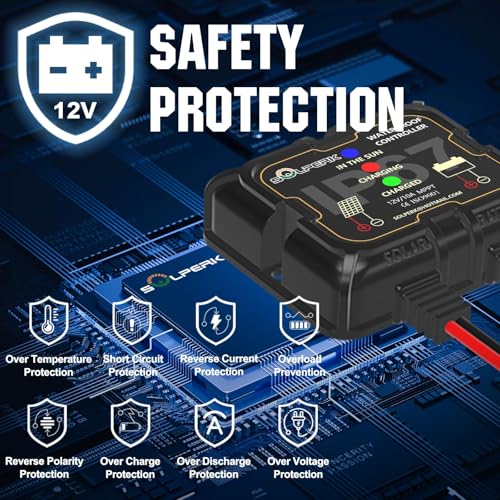
If you want a compact controller for a simple 12V portable setup, this SOLPERK model is a strong fit. It uses MPPT charging for better efficiency than basic PWM controllers, supports common battery types, and includes clear indicator lights that make it beginner-friendly. The waterproof design also suits outdoor use where weather resistance matters.
✓ Pros
- MPPT charging for improved efficiency in portable setups
- Designed for 12V batteries and compact use
- Compatible with AGM, gel, flooded, and LiFePO4 batteries
- Built-in protection features for safer operation
- LED indicators make status checks simple
✗ Cons
- Best suited to 12V systems, not multi-voltage flexibility
- 10A capacity may be limiting for larger portable arrays
- Fewer advanced customization options than app-based models
Best for Multi-Voltage Flexibility and Remote Monitoring: 20A 12V/24V MPPT Wireless Solar Charge Controller, Bateria Power Intelligent Solar Panel Regulator 20 Amp BT App Function


This Bateria Power controller is a smart option if you want more control over a portable system. It supports 12V and 24V batteries, offers MPPT charging, and adds phone app monitoring for users who like to track performance remotely. It’s especially appealing for more advanced portable builds where customization matters.
✓ Pros
- Supports both 12V and 24V portable systems
- MPPT charging with strong efficiency focus
- Phone app monitoring adds convenience
- Custom parameter settings for advanced users
- Works with multiple battery chemistries, including LiFePO4
✗ Cons
- More features than some beginners need
- Setup may be more involved than a basic controller
- Requires attention to voltage and connection sequence limits
Best Budget Option for Basic Portable Builds: ACEIRMC 2pcs 30A Solar Charge Controller 12V/ 24V Solar Panel Charge Controller


If you’re building a low-cost portable solar kit and want useful features without overcomplicating the setup, this ACEIRMC controller is worth a look. It supports 12V and 24V systems, includes an LCD display, and adds dual USB output plus timer settings. It uses PWM charging, which makes it better suited to straightforward systems than efficiency-focused premium builds.
✓ Pros
- Budget-friendly choice for simple portable systems
- Supports both 12V and 24V setups
- LCD display improves usability
- Dual USB output adds convenience
- Includes multiple automatic protection features
✗ Cons
- PWM charging is less efficient than MPPT
- Best for lead-acid battery types rather than broader chemistry support
- Less ideal for users who want maximum charging performance
Budget Guide: What You Get at Each Tier
Budget Tier
Budget controllers are usually the best fit for simple portable systems where the main goal is basic battery charging and easy setup. You can expect straightforward controls, display screens, and protection features, but often with PWM charging instead of MPPT. These models are practical for small kits, occasional use, or users who don’t need advanced tuning.
Mid-Range Tier
Mid-range controllers tend to offer the best balance for most portable buyers. This is where you usually find MPPT charging, better battery compatibility, stronger protection features, and more useful monitoring tools. If you want a controller that can grow with a more serious portable setup, this tier is often the sweet spot.
Premium Tier
Premium controllers are aimed at users who want remote monitoring, custom charging parameters, and more flexible system support. They’re a strong match for advanced portable builds, especially if you use different battery types or want to monitor performance from a phone. The tradeoff is that setup complexity can be higher than with simpler models.
Frequently Asked Questions
What size solar charge controller do I need for a portable system?
Choose a controller that can comfortably handle your panel output and battery setup without running at its limit. For portable systems, it’s usually smart to leave some headroom rather than sizing it exactly at the edge.
Is MPPT better than PWM for portable solar setups?
Yes, in most cases. MPPT is typically the better choice because it extracts more usable power from the panel and performs better when sunlight conditions change. PWM can still work for basic, low-cost systems.
Can I use a 12V controller with a lithium battery?
Only if the controller explicitly supports lithium or LiFePO4 charging. Battery chemistry support matters because the charging profile must match the battery type for safe and effective charging.
Do I need a 12V/24V controller for a portable system?
If you may expand your setup or already use different system voltages, a 12V/24V controller gives more flexibility. If you know you’ll stay with a small 12V kit, a 12V-only controller may be enough.
What is the biggest mistake buyers make when choosing a controller?
The biggest mistake is focusing only on amp rating and ignoring battery compatibility, charging method, and protection features. For portable systems, the right match matters more than the biggest number on the box.
Pros
- + MPPT improves charging efficiency for portable systems
- + Battery chemistry compatibility matters for safe charging
- + Protection features reduce risk during frequent setup changes
- + Compact, portable designs are easier to pack and move
- + Monitoring tools make setup and troubleshooting easier
Cons
- – Amp rating alone does not guarantee a better controller
- – PWM models are less efficient than MPPT
- – Wrong battery chemistry settings can shorten battery life
- – Some controllers are limited to one system voltage
Frequently asked questions
- What size solar charge controller do I need for a portable system?
- Choose a controller that can comfortably handle your panel output and battery setup without running at its limit. For portable systems, it’s usually smart to leave some headroom rather than sizing it exactly at the edge.
- Is MPPT better than PWM for portable solar setups?
- Yes, in most cases. MPPT is typically the better choice because it extracts more usable power from the panel and performs better when sunlight conditions change. PWM can still work for basic, low-cost systems.
- Can I use a 12V controller with a lithium battery?
- Only if the controller explicitly supports lithium or LiFePO4 charging. Battery chemistry support matters because the charging profile must match the battery type for safe and effective charging.
- Do I need a 12V/24V controller for a portable system?
- If you may expand your setup or already use different system voltages, a 12V/24V controller gives more flexibility. If you know you’ll stay with a small 12V kit, a 12V-only controller may be enough.
- What is the biggest mistake buyers make when choosing a controller?
- The biggest mistake is focusing only on amp rating and ignoring battery compatibility, charging method, and protection features. For portable systems, the right match matters more than the biggest number on the box.
Get the Full Outdoor Buyer's Guide
Join our free newsletter — we'll send our latest Outdoor picks, specs and verdicts straight to your inbox.
Free. No spam. Unsubscribe anytime.
Was this review helpful?
Be the first to share your feedback on this review.
Sign in to vote and let us know what you think.
Discussion (0)
No comments yet. Be the first to start the discussion.
Related Reviews

EcoFlow DELTA Pro Ultra Review (2026): Specs, Pros & Cons, and Who It's For
Check Price on Amazon →
How to Choose the Best Portable Power Station for Camping in 2026: Complete Buying Guide
If you’re trying to figure out how to choose a portable power station for camping , the hardest part is usually not the brand name—it’s matching the battery, output, and charging options to the way you actually camp. Pick the wrong size and you’ll either run out of power too soon or carry more weigh
