

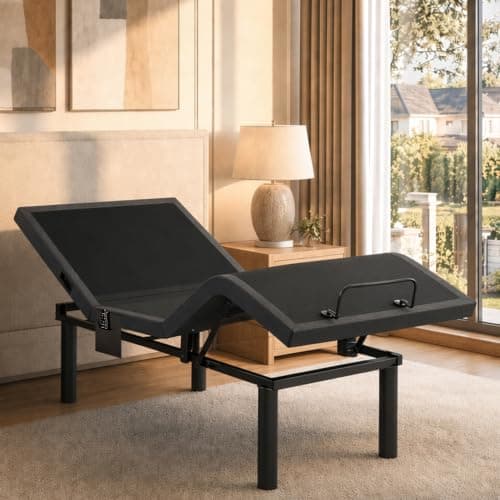
What is Adjustable Bed Benefits and Drawbacks? A Complete 2026 Guide
An adjustable bed can make reading, sleeping, and recovery feel much easier, but it is not the right fit for every household or budget. If you are comparing adjustable bed benefits and drawbacks, the biggest question is whether the comfort and support gains are worth the added cost and complexity. This guide breaks down how they work, who they help most, what to watch for before buying, and which models stand out in 2026.
Related Reviews
How It Works
An adjustable bed uses an electric base with motors that raise and lower different sections of the frame, most commonly the head and foot areas. By changing your sleeping angle, the bed can reduce pressure points, improve positioning for reading or watching TV, and help some people breathe more comfortably while lying down.
Most modern adjustable bases use a wired or wireless remote, preset positions like zero gravity, and quiet lift motors. More advanced models may also include USB ports, under-bed lighting, massage functions, lumbar support, or height adjustment, depending on whether the product is a consumer sleep base or a medical-style hospital bed.
The core technology is simple: a motorized hinge system moves the mattress platform into a new shape while the mattress flexes with it. Because of that, mattress compatibility matters a lot, and many buyers do best with memory foam, latex, or hybrid mattresses designed to bend smoothly.
Key Benefits & Use Cases
When people search for adjustable bed benefits and drawbacks, they are usually trying to figure out whether the advantages are practical or just nice-to-have. In many cases, the benefits are very real, especially for comfort, recovery, and nighttime positioning.
1. Better comfort for sleeping and relaxing
Adjustable beds let you fine-tune your position instead of lying flat all night. That can be helpful if you prefer a slight incline, want to sit up to read, or simply need a more personalized sleep setup.
2. Potential relief for snoring and breathing discomfort
Raising the head of the bed may help some sleepers feel less congested or reduce snoring-related issues. It is not a cure, but it can be a useful non-drug comfort solution for certain people.
3. Easier pressure management
Changing positions can reduce the feeling of pressure on the lower back, shoulders, or hips. This is one reason adjustable bases are popular with people who spend a lot of time in bed or who need support after surgery.
4. Better support for recovery and mobility needs
Some medical-style adjustable beds go beyond head and foot movement and include standing assistance, height adjustment, safety rails, and meal trays. These are especially useful for seniors, caregivers, and people with limited mobility.
5. More flexible lifestyle use
Many buyers use adjustable beds for everyday convenience: watching TV, working from bed, charging devices, or finding a zero-gravity position for relaxation. That versatility is a major reason they have become more common in home bedrooms.
What to Look For When Buying
If you are weighing adjustable bed benefits and drawbacks, the right buying criteria can prevent disappointment later. Here are the five most important things to compare before you choose a base.
1. Adjustability range
Look at how far the head and foot sections move, and whether the base offers presets like zero gravity or anti-snore. More range usually means more comfort options.
2. Mattress compatibility
Not every mattress bends equally well. Memory foam, latex, and many hybrids work best, while some innerspring mattresses may not flex comfortably or may reduce the bed’s motion benefits.
3. Motor noise and smoothness
A quiet motor matters if you plan to adjust the bed at night or share a room. Smooth movement is also important because jerky operation can feel less stable and less premium.
4. Weight capacity and durability
Check the supported weight rating and any cycle testing information. A stronger frame and proven motor durability can make a big difference in long-term value.
5. Extra features that match your needs
USB ports, under-bed lights, massage, remote memory positions, safety rails, or height adjustment can be useful, but only if you will actually use them. Extra features should support your needs, not inflate the price unnecessarily.
Top Recommended Products
Below are the standout options from the provided list. The first two are consumer-friendly adjustable bases, while the other two are more specialized medical-style beds for recovery or care settings.
Marsail Twin XL Adjustable Bed Frame,Adjustable Bed Base with Wireless Remote,Zero Gravity,Head & Foot Incline,Quiet Motor,Dual USB Ports,Memory Positions,Adjustable Legs,Ergonomic Design $269.99 ✓ Prime
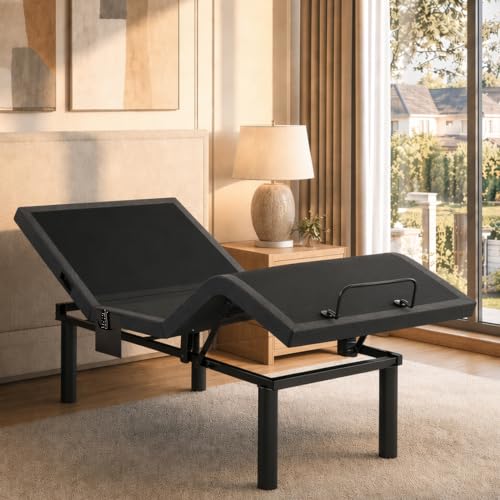


This Marsail base is the strongest value pick for shoppers who want the adjustable bed experience without paying luxury pricing. It combines head and foot articulation, zero-gravity positioning, quiet motors, USB charging, and a high weight capacity, which makes it a practical entry point for many bedrooms.
- ✓ Independent head and foot adjustments for personalized positioning
- ✓ Zero gravity and preset memory positions for easier comfort control
- ✓ Dual USB-A and USB-C ports for bedside charging
- ✓ Quiet dual motors and stable everyday operation
- ✓ Supports up to 750 lbs and is tested for 50,000 lift cycles
- ✓ Prime shipping and a budget-friendly price for the feature set
- ✗ Twin XL size only, so it is not a fit for larger mattress needs
- ✗ Lacks luxury extras like massage or under-bed lighting
- ✗ Better suited to comfort-focused use than medical or mobility support
Sven & Son Bliss Adjustable Bed Base Frame Only, Head and Foot Lift, Lumbar Support, Head-Pillow-Tilt, Massage, Under-Bed Lights, USB, Memory Positions, Zero Gravity - Queen $1169.95 ✓ Prime
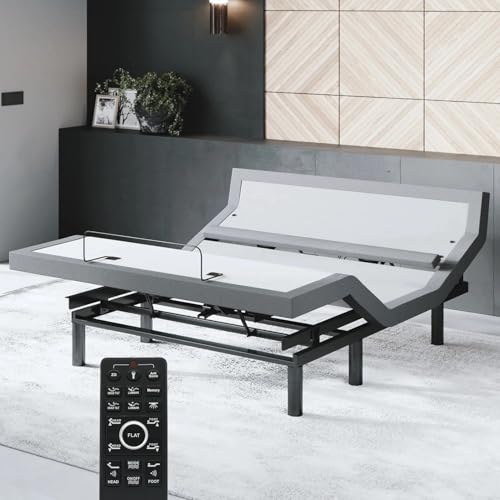


The Sven & Son Bliss is the more premium comfort pick in this list. It stands out for deeper adjustability, lumbar support, massage modes, and a 25-year warranty, making it attractive for buyers who want a more feature-rich sleep setup.
- ✓ Head lift up to 75° and foot lift up to 45° for broad positioning range
- ✓ Lumbar support and head-pillow tilt for more targeted comfort
- ✓ Massage modes, USB ports, and under-bed lights add convenience
- ✓ Memory positions make favorite settings easy to return to
- ✓ 25-year warranty adds long-term peace of mind
- ✓ Compatible with multiple mattress types, including latex, memory foam, spring, and air
- ✗ Much higher price than entry-level options
- ✗ Features may be more than casual shoppers need
- ✗ Queen size only in this listing
Adjustable Hospital Bed for Seniors Elderly with Mattress, Electric Lift Bed with Remote, Fall-Safe Frame&Meal Tray,Head&Foot Incline,Adjustable Bed Base for Safe Lying/Standing/Aid/Sitting,Twin $1159.00 ✓ Prime
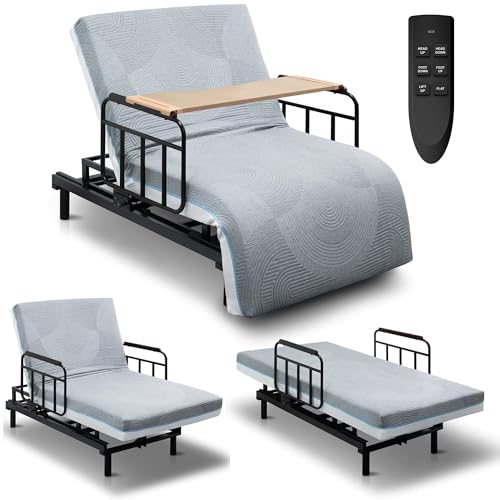
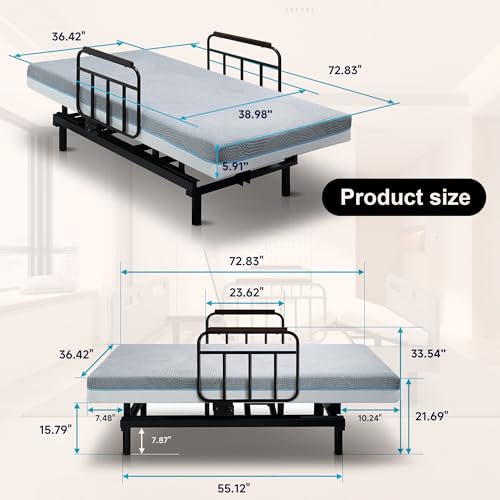
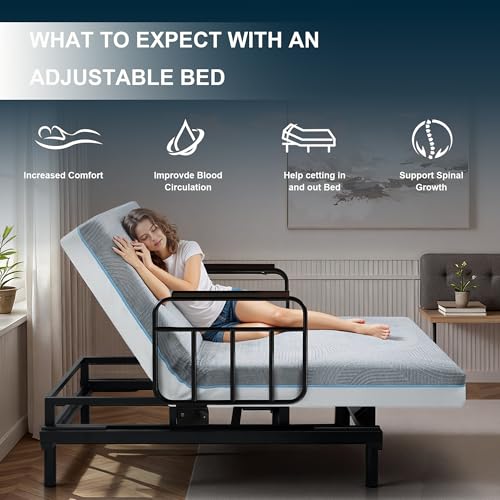
This model is best understood as a care-focused bed rather than a typical bedroom upgrade. Its standing assistance, safety rails, and tray make it especially relevant for seniors, post-surgery recovery, and users who need help with daily transfers.
- ✓ Assisted standing and sitting support for mobility needs
- ✓ Safety handrails and fall-prevention design
- ✓ Includes a mattress and meal tray for practical care use
- ✓ Quiet motor and 50,000+ cycle durability
- ✓ Suitable for home recovery spaces and caregiving setups
- ✓ Prime shipping included
- ✗ More expensive than standard consumer adjustable bases
- ✗ Medical-style design may be unnecessary for casual bedroom use
- ✗ Twin size and care-oriented features limit general sleep appeal
YIDE Premium 5-Function Full Electric ICU Hospital Bed – Height Adjustable 17-39", Backrest 0-75°, Leg Rest 0-45°, Grey $1600.00 ✓ Prime
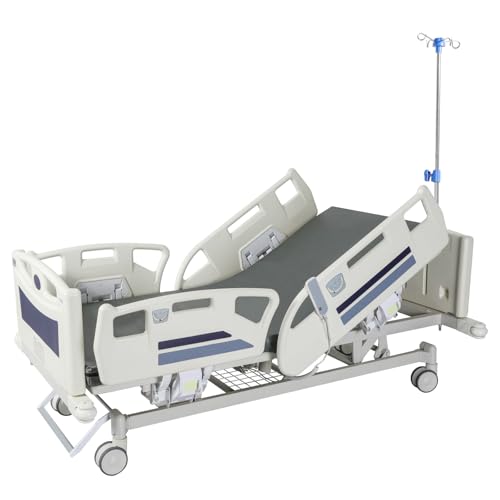


The YIDE bed is the most specialized option here, built for hospital, hospice, and rehab settings. It is not a normal consumer adjustable bed, but it is highly relevant if the goal is care, transfer support, and medical-grade positioning.
- ✓ Five electric adjustment functions for highly specific positioning
- ✓ Height adjustment supports caregiving and transfers
- ✓ Includes a viscoelastic foam mattress and accessory pole
- ✓ 550-pound capacity and casters for mobility
- ✓ Designed for home, hospice, and rehab use
- ✓ Prime availability
- ✗ Highest price in the group
- ✗ Too medical for most everyday bedroom shoppers
- ✗ Best suited to care environments rather than general comfort upgrades
Common Mistakes to Avoid
Understanding adjustable bed benefits and drawbacks also means knowing what can go wrong during the buying process. These are the most common mistakes shoppers make.
Buying the wrong mattress type
Some buyers assume any mattress will work equally well. In reality, a mattress that is too stiff or not designed to flex can reduce comfort and limit the bed’s movement.
Ignoring room size and clearance
Adjustable bases can be heavier and bulkier than standard frames. If the room is tight, the bed may be harder to place or use comfortably.
Choosing features you will not use
Massage, lighting, memory settings, and height adjustment are useful only if they match your routine. Paying extra for unused features is one of the easiest ways to overspend.
Overlooking noise and motion quality
A bed can look great on paper but still feel annoying if the motor is loud or the movement is jerky. Quiet operation is especially important if you share a room.
Confusing consumer and medical models
Not every adjustable bed is meant for the same purpose. A luxury sleep base and a hospital-style recovery bed solve different problems, so make sure the product matches your actual need.
Frequently Asked Questions
Are adjustable beds worth it?
They can be worth it if you want more comfort, better positioning for sleep or reading, or help with snoring and recovery. The value is strongest when you will use the adjustability regularly.
What are the main adjustable bed benefits and drawbacks?
The main benefits are comfort, position control, and convenience. The main drawbacks are higher cost, more complexity, and the need to choose a compatible mattress.
What kind of mattress works best on an adjustable bed?
Memory foam, latex, and many hybrid mattresses usually work best because they flex more easily. Some innerspring mattresses may not bend as well or may feel less comfortable on an adjustable base.
Do adjustable beds help with snoring?
They may help some people by slightly elevating the head and upper body. Results vary, and they are not a replacement for medical treatment if snoring is caused by a health issue.
Are adjustable beds good for seniors?
Yes, especially if the bed includes easy remote controls, safer positioning, or mobility-support features. Medical-style models can be particularly helpful for seniors who need assistance with standing, sitting, or recovery.
Pros
- + Customizable head and foot positioning
- + Can improve comfort for reading, relaxing, and sleeping
- + May help with snoring and pressure relief
- + Useful for recovery and mobility support
- + Extra conveniences like USB ports and memory presets
Cons
- – Higher cost than standard bed frames
- – Mattress compatibility matters
- – Can be bulky and feature-heavy
- – Some models are too medical for casual use
Frequently asked questions
- Are adjustable beds worth it?
- They can be worth it if you want more comfort, better positioning for sleep or reading, or help with snoring and recovery. The value is strongest when you will use the adjustability regularly.
- What are the main adjustable bed benefits and drawbacks?
- The main benefits are comfort, position control, and convenience. The main drawbacks are higher cost, more complexity, and the need to choose a compatible mattress.
- What kind of mattress works best on an adjustable bed?
- Memory foam, latex, and many hybrid mattresses usually work best because they flex more easily. Some innerspring mattresses may not bend as well or may feel less comfortable on an adjustable base.
- Do adjustable beds help with snoring?
- They may help some people by slightly elevating the head and upper body. Results vary, and they are not a replacement for medical treatment if snoring is caused by a health issue.
- Are adjustable beds good for seniors?
- Yes, especially if the bed includes easy remote controls, safer positioning, or mobility-support features. Medical-style models can be particularly helpful for seniors who need assistance with standing, sitting, or recovery.
Get the Full Home Buyer's Guide
Join our free newsletter — we'll send our latest Home picks, specs and verdicts straight to your inbox.
Free. No spam. Unsubscribe anytime.
Was this review helpful?
Be the first to share your feedback on this review.
Sign in to vote and let us know what you think.
Discussion (0)
No comments yet. Be the first to start the discussion.
Related Reviews

What is How to Keep Bed Cool in Summer? A Complete 2026 Guide
If you’re wondering how to keep bed cool in summer, the problem usually comes down to trapped body heat, poor airflow, and bedding that holds onto warmth. The good news is that you can make a bed feel noticeably cooler with the right materials, sleep setup, and a few smart habits. This guide explain
Brooklinen vs Parachute Sheets (2026): Which Should You Actually Buy?
Brooklinen leans into a true hotel-style aesthetic: crisp percale, a clean white finish, and a luxury-first positioning that immediately signals premium bedding. The fabric story is straightforward and familiar—100% long-staple cotton with a breathable 270 thread count weave.
What is How Often to Replace a Mattress? A Complete 2026 Guide
If you’re wondering how often to replace a mattress , you’re probably dealing with aches, sagging, poor sleep, or the nagging feeling that your bed just isn’t supporting you anymore. The short answer is that most mattresses should be replaced every 7 to 10 years, but the real timeline depends on mat