

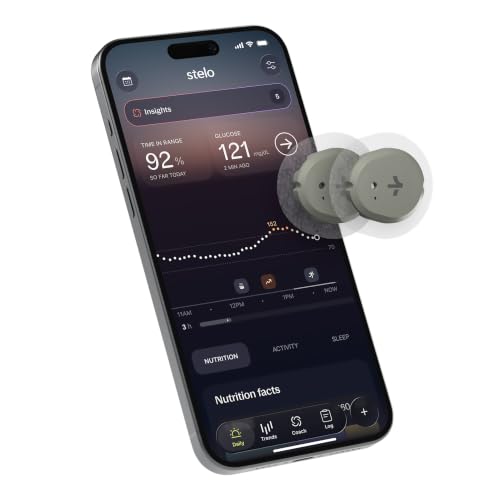
Who this is for: Best for adults seeking non-insulin CGM tracking with app-based insights for nutrition and lifestyle habits.
At a Glance
| Category | Stelo Glucose Biosensor & App | Lingo Continuous Glucose Monitor |
|---|---|---|
| Brand | Dexcom | Abbott |
| Wear Time | Up to 15 days per biosensor | Up to 14 days per biosensor |
| Intended User | Adults 18+ not using insulin | Adults looking to optimize nutrition and glucose habits |
| App Experience | AI coaching, meal/activity logging, pattern insights, deep dives | Real-time data, nutrition insights, lifestyle tracking |
| Ecosystem Sync | Apple Health, Google Health Connect, Oura | iOS and Android app support |
| Eligibility Notes | Not for insulin users; other restrictions apply | HSA/FSA eligible; no prescription needed |
Design
Winner: Stelo

Both products are app-first CGM systems, so the real design question is how cleanly each one fits into daily life. Stelo stands out because its feature set is framed around seamless syncing, coaching, and deeper insight layers, which makes it feel more polished for users who want a more guided experience. Lingo is also straightforward and mobile-centric, but its presentation is more focused on nutrition optimization than on broader lifestyle integration.
Related Reviews
For buyers who want a more connected experience across health platforms, Stelo has the edge.
Why Stelo wins: broader integration and a more coach-like app experience.
✓ Pros
- AI-powered coaching and personalized insights
- Syncs with Apple Health, Google Health Connect, and Oura
- Built for 24/7 tracking with a guided app experience
- 15-day wear time supports fewer sensor changes
✗ Cons
- Only for adults not using insulin
- Has several use restrictions that narrow the audience
- Premium positioning may not suit budget-focused buyers
Performance
Winner: Stelo


On paper, both systems deliver continuous glucose tracking and lifestyle insights, but Stelo appears to offer the more advanced analytics package. Its AI-powered coaching, trend summaries, deep dives, and pattern insights give it a stronger performance profile for people who want more than raw data. Lingo is solid for real-time glucose feedback tied to meals, exercise, sleep, and other habits, and it is especially compelling for users focused on nutrition behavior change.
If you want the richer insight engine, Stelo is the better performer overall.
Why Stelo wins: more advanced insights and coaching tools.
✓ Pros
- AI-powered coaching with deep-dive insights
- Trend summaries and pattern detection
- 24/7 tracking with broad app integrations
- Longer 15-day sensor wear time
✗ Cons
- Not intended for insulin users
- Health restrictions limit who can use it safely
- May be more than casual users need
Value
Winner: Lingo
Lingo takes the value category because it is positioned as the more budget-friendly option and includes a key convenience advantage: no prescription needed. That combination makes it easier to justify for first-time CGM shoppers or people who want a simpler entry point into glucose tracking. Stelo may offer more features, but Lingo gives many buyers the cleaner value proposition if their main goal is understanding how food and lifestyle affect glucose.
For cost-conscious shoppers, Lingo is the smarter buy.
Why Lingo wins: lower tier positioning plus easier access.
✓ Pros
- Budget-tier option in this comparison
- HSA/FSA eligible
- No prescription needed
- Strong focus on nutrition and habit optimization
✗ Cons
- Shorter 14-day wear time than Stelo
- US-only listing limits flexibility
- Fewer ecosystem integrations than Stelo
Battery/Durability
Winner: Stelo
Neither product is evaluated here like a traditional battery-powered gadget, but durability can be compared through sensor lifespan and replacement cadence. Stelo wins because each biosensor lasts up to 15 days, giving it a slight endurance advantage over Lingo’s up-to-14-day sensor. That extra day may not sound dramatic, but over repeated use it can mean fewer sensor swaps and a little less hassle.
If your priority is minimizing replacement frequency, Stelo has the edge.
Why Stelo wins: longer sensor wear time and replacement support.
✓ Pros
- Up to 15 days per biosensor
- Replacement support if a biosensor issue occurs before wear time ends
- Designed for continuous 24/7 use
- Fewer swaps than Lingo over time
✗ Cons
- Still a wearable sensor that must be replaced regularly
- Durability depends on correct use and skin adherence
- Not suitable for every medical situation
Setup and App Experience
Winner: Stelo
Both products rely on companion apps, but Stelo’s app experience sounds more feature-rich overall. It offers AI-powered coaching, advanced meal and activity logging, trend summaries, and deep dives, which makes the setup-to-insight journey feel more complete. Lingo’s app is also useful, especially for seeing how food, exercise, sleep, and other factors affect glucose, but its story is more narrowly centered on nutrition learning.
If you want the app to do more than display data, Stelo is the better pick.
Why Stelo wins: richer coaching and logging tools.
✓ Pros
- AI-powered coaching built into the app
- Advanced meal and activity logging
- Trend summaries and deep dives for pattern spotting
- Syncs with major health platforms
✗ Cons
- More features may feel overwhelming to some users
- Only for non-insulin users 18+
- Not the simplest entry-level option
Stelo Is the Better Choice If…
- You want the more feature-rich app experience.
- You care about AI coaching, trend summaries, and deep dives.
- You want longer sensor wear time.
- You already use Apple Health, Google Health Connect, or Oura.
- You are not using insulin and fit the product’s eligibility rules.
Lingo Is the Better Choice If…
- You want the more budget-friendly option.
- You want no-prescription access.
- Your main goal is nutrition optimization and habit learning.
- You prefer a simpler glucose-focused experience.
- You are in the US and want a straightforward CGM entry point.
Our Final Verdict
Overall winner: Stelo. In this Stelo vs Lingo CGM comparison, Stelo wins because it offers the stronger all-around package: longer wear time, more advanced coaching, better ecosystem syncing, and a more robust app experience. That makes it the better choice for most people who want a premium, insight-driven CGM experience rather than just basic glucose visibility.
Lingo still makes a lot of sense if your top priority is value and easier access. It is the better pick for shoppers who want a lower-friction way to learn how food and lifestyle affect glucose without paying for extra bells and whistles. But if you want the most complete feature set, Stelo is the one to buy.
Frequently Asked Questions
Is Stelo better than Lingo CGM?
For most buyers, yes. Stelo is the better overall pick because it offers longer wear time, richer coaching features, and more health ecosystem integrations.
Is Lingo cheaper than Stelo?
Lingo is the budget-tier option in this comparison, so it is the better value choice if you want a more affordable entry into CGM tracking.
Do I need a prescription for Lingo?
No. The product listing says Lingo does not require a prescription, which makes it easier to buy for many shoppers.
Who should not use Stelo?
Stelo is not for people using insulin, and it also should not be used by people on dialysis, those with problematic hypoglycemia, or those with certain other restrictions listed by the manufacturer.
Which CGM is better for nutrition tracking?
Both are useful for nutrition tracking, but Lingo is especially focused on helping you learn how specific foods and habits affect glucose, while Stelo adds more coaching and deeper analysis.
Pros
- + Stelo has longer 15-day wear time
- + Stelo offers AI coaching and deeper insights
- + Stelo syncs with Apple Health, Google Health Connect, and Oura
- + Lingo is the budget-friendly option
- + Lingo requires no prescription
Cons
- – Stelo is not for insulin users
- – Stelo has several eligibility restrictions
- – Lingo has shorter 14-day wear time
- – Lingo offers fewer ecosystem integrations
- – Lingo is US-only
Frequently asked questions
- Is Stelo better than Lingo CGM?
- For most buyers, yes. Stelo is the better overall pick because it offers longer wear time, richer coaching features, and more health ecosystem integrations.
- Is Lingo cheaper than Stelo?
- Lingo is the budget-tier option in this comparison, so it is the better value choice if you want a more affordable entry into CGM tracking.
- Do I need a prescription for Lingo?
- No. The product listing says Lingo does not require a prescription, which makes it easier to buy for many shoppers.
- Who should not use Stelo?
- Stelo is not for people using insulin, and it also should not be used by people on dialysis, those with problematic hypoglycemia, or those with certain other restrictions listed by the manufacturer.
- Which CGM is better for nutrition tracking?
- Both are useful for nutrition tracking, but Lingo is especially focused on helping you learn how specific foods and habits affect glucose, while Stelo adds more coaching and deeper analysis.
Score breakdown
- value
- 7.0
- usability
- 8.0
- durability
- 8.0
- performance
- 8.0
- buyerFeedback
- 7.0
Get the Full Health & Fitness Buyer's Guide
Join our free newsletter — we'll send our latest Health & Fitness picks, specs and verdicts straight to your inbox.
Free. No spam. Unsubscribe anytime.
Was this review helpful?
Be the first to share your feedback on this review.
Sign in to vote and let us know what you think.
Discussion (0)
No comments yet. Be the first to start the discussion.
Related Reviews
8 Best Glucose Monitors in 2026 — Smarter Tracking for Better Daily Control
If you’re trying to find the best glucose monitors 2026 has to offer, the challenge is choosing between modern CGMs and traditional fingerstick kits without getting stuck on confusing specs. This guide narrows the field to research-backed picks that stand out for accuracy, ease of use, app support,

8 Best Pulse Oximeters in 2026 — Most Accurate Picks for Fast, Easy Readings
If you’re trying to find the best pulse oximeters 2026 has to offer, the hardest part is separating simple fingertip models from the ones that are actually easier to read, more reliable, and better built. This roundup focuses on pulse oximeters with clear displays, useful extras, and features that m
Stelo CGM Review (2026): Specs, Pros & Cons, and Who It's For
Stelo is designed around simplicity, which is a big part of its appeal. Based on the product specs and owner feedback patterns, this is not a complicated medical gadget that demands frequent fiddling; it is built for people who want a low-friction way to monitor glucose trends in the background.