

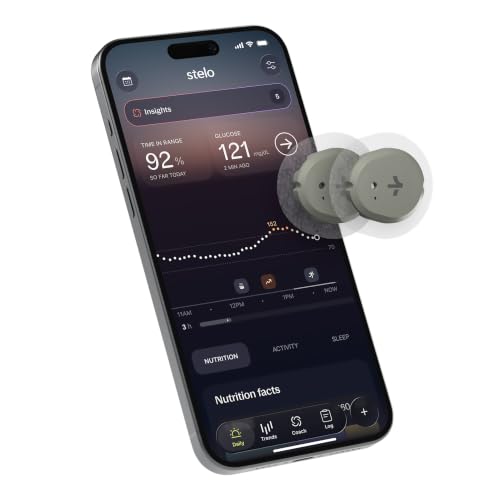
Who this is for: Best for adults not using insulin who want convenient glucose trend tracking and app-based insights.
Check PriceStelo CGM Review (2026): Specs, Pros & Cons, and Who It's For
Key Specifications
| Spec | Details |
|---|---|
| Product | Stelo Glucose Biosensor & App—2-Pack (Up to 15 Days Each) |
| Brand | Dexcom |
| Compatibility | iOS and Android |
| Wear Time | Up to 15 days per biosensor |
| Tracking | 24/7 glucose tracking with personalized insights |
| Target User | Adults 18+ who are not using insulin |
| Support | SteloBot in-app support plus live agent support during business hours |
| Integrations | Apple Health, Google Health Connect, and Oura sync |
Design & Build Quality
Stelo is designed around simplicity, which is a big part of its appeal. Based on the product specs and owner feedback patterns, this is not a complicated medical gadget that demands frequent fiddling; it is built for people who want a low-friction way to monitor glucose trends in the background.
Related Reviews
- 8 Best Thermometers in 2026 — Fast, Accurate Picks for Families, Babies, and Home Use
- 8 Best Body Fat Scales Accuracy in 2026 — Most Reliable Picks for Tracking Body Composition at Home
- Etekcity Smart Scale for Body Weight, Body Fat and BMI, FSA Eligible Review (2026): Specs, Pros & Cons, and Who It's For
The biosensor format is especially appealing for users who dislike bulky wearables or constant manual logging. Because each sensor lasts up to 15 days, the design favors set-it-and-monitor-it convenience rather than daily maintenance. That makes it a practical option for busy adults who want data without a steep learning curve.

Dexcom’s reputation also matters here. While this review is research-based rather than hands-on, the brand association tends to reassure buyers who want a more established name in continuous glucose monitoring. That said, the product is clearly positioned for a narrower audience than traditional diabetes CGMs, so the build and setup are best judged through the lens of lifestyle tracking, not insulin management.
Pros
- Up to 15-day wear per biosensor reduces frequent replacements.
- Simple app-first design suits users who want easy glucose visibility.
- Works with iOS and Android.
- Backed by Dexcom, a recognized name in glucose monitoring.
Cons
- Only for adults 18+ who are not using insulin.
- Not appropriate for several clinical situations, including dialysis and problematic hypoglycemia.
- Less flexible than a full medical CGM for people with more complex glucose-management needs.
Performance & Features

Performance-wise, the biggest strength of Stelo is continuous visibility. Rather than relying on occasional finger-prick checks or sporadic logging, it gives users around-the-clock glucose tracking and then turns that data into personalized insights. For many people, that is the real value: not just numbers, but patterns they can actually act on.
The feature set is noticeably modern. According to the product listing, Stelo includes AI-powered coaching, nutrition insights, glucose insights, advanced meal and activity logging, trend summaries, and deeper pattern analysis. In practical terms, that means the app is doing more than collecting data — it is trying to help users understand what affects their glucose levels.
Integration support is another plus. Syncing with Apple Health, Google Health Connect, and Oura makes Stelo more useful for people already living inside a broader health-tracking ecosystem. That can be especially helpful for users who care about sleep, activity, and nutrition alongside glucose trends.

Support is also a meaningful feature. SteloBot is available 24/7 in the app, and live agent support is available during regular business hours. For a product that depends on app reliability and sensor use, that kind of support structure adds confidence, especially for first-time CGM-style users.
There are, however, important boundaries. The product itself clearly states it is not for insulin users and not for several other groups, so its performance should be viewed as lifestyle and awareness support, not a universal glucose solution. That limitation is not a flaw so much as a reminder that Stelo is intentionally specialized.
Pros
- 24/7 glucose tracking with personalized insights.
- AI-powered coaching and deeper pattern analysis.
- Nutrition, meal, and activity logging help connect habits to glucose trends.
- Integrates with Apple Health, Google Health Connect, and Oura.
- 24/7 virtual support through SteloBot.
Cons
- Not suitable for insulin users.
- Not meant for every medical use case involving glucose management.
- App-driven insights may feel excessive for buyers who only want basic tracking.
Value for Money
When people ask whether the Stelo CGM is worth it, the real question is whether the feature set matches the buyer’s needs. For adults who want glucose awareness, app-based coaching, and a relatively hands-off monitoring experience, the value proposition is strong. You are paying for convenience, data visibility, and ecosystem-friendly tracking rather than just a sensor.
The 2-pack format also improves the value equation because it provides multiple wear cycles in one purchase. Since each biosensor lasts up to 15 days, the package structure makes sense for users who want to build a short-to-medium-term tracking habit or compare how food, exercise, and routine changes affect their readings over time.
Where value drops is for buyers who do not need continuous tracking or who fall outside the intended user profile. If you are on insulin, have a more medically complex situation, or simply want a basic health gadget with minimal app involvement, Stelo may feel like overkill. In other words, it is a good value only when the use case matches the product’s design.
Pros
- Strong feature set for the intended audience.
- 2-pack format supports longer tracking periods.
- Useful for spotting patterns around food and activity.
Cons
- Not a good fit if you need a general-purpose CGM for insulin management.
- Value depends heavily on whether you will use the app insights consistently.
- May be more product than some casual wellness users need.
Who Should Buy This
Stelo is best for adults 18 and older who are not using insulin and want to understand how their daily habits affect glucose trends. It is especially appealing if you like app-guided health tools, want continuous visibility instead of occasional checks, and prefer a product that can sync with other health platforms.
It also makes sense for buyers who value convenience. If you are looking for a wearable that can quietly collect data, summarize patterns, and help you make sense of meals and activity without a lot of manual work, Stelo fits that brief well.
Based on the research, this is a strong pick for:
- Adults exploring glucose awareness for lifestyle reasons
- Users who want app-based insights and coaching
- People who already use Apple Health, Google Health Connect, or Oura
- Buyers who want a simple, low-maintenance wearable experience
Who Should Look Elsewhere
Stelo is not the right choice for everyone, and the product page is explicit about that. If you use insulin, have problematic hypoglycemia, are on dialysis, are modifying medication without healthcare professional consultation, or have a history of eating disorders, this is not the product for you.
You should also look elsewhere if you want a more traditional medical CGM experience for managing a complex condition. Stelo is designed for a narrower audience, and forcing it into the wrong use case would undercut its strengths and potentially create confusion.
In short, skip Stelo if you:
- Need a CGM for insulin use
- Want a device for a medically complex glucose plan
- Prefer a very basic tracker without app coaching
- Do not plan to use the insights and integrations
Final Verdict
So, is the Stelo CGM worth it? For the right buyer, yes. If you are an adult who is not using insulin and you want reliable glucose trend tracking with modern app features, Stelo looks like a smart, research-backed choice. Its biggest strengths are convenience, personalized insights, and integration with other health platforms.
If you are outside its intended audience, though, it is an easy skip. The product is clearly focused, and that focus is what makes it useful. For the right person, it is a compelling wearable that turns glucose tracking into something more actionable and less intimidating.
Frequently Asked Questions
Is Stelo worth it for non-insulin users?
Yes, Stelo appears worth it for non-insulin users who want continuous glucose tracking, app-based insights, and a simple wearable experience tailored to lifestyle monitoring.
Can you use Stelo if you take insulin?
No. The product listing says Stelo is not for people using insulin, so it is not intended for that use case.
How long does each Stelo biosensor last?
Each biosensor is designed to last up to 15 days, which helps reduce how often you need to replace it.
Does Stelo work with iPhone and Android?
Yes. The product is listed as compatible with both iOS and Android.
What makes Stelo different from a basic glucose tracker?
Stelo combines continuous tracking with AI-powered coaching, nutrition and activity logging, trend summaries, and health app integrations, making it more feature-rich than a basic tracker.
Pros
- + Up to 15-day wear per biosensor
- + 24/7 glucose tracking with personalized insights
- + AI-powered coaching and deeper pattern analysis
- + Integrates with Apple Health, Google Health Connect, and Oura
- + 24/7 virtual support through SteloBot
Cons
- – Not suitable for insulin users
- – Not for several medical use cases
- – May be more than casual users need
Frequently asked questions
- Is Stelo worth it for non-insulin users?
- Yes, Stelo appears worth it for non-insulin users who want continuous glucose tracking, app-based insights, and a simple wearable experience tailored to lifestyle monitoring.
- Can you use Stelo if you take insulin?
- No. The product listing says Stelo is not for people using insulin, so it is not intended for that use case.
- How long does each Stelo biosensor last?
- Each biosensor is designed to last up to 15 days, which helps reduce how often you need to replace it.
- Does Stelo work with iPhone and Android?
- Yes. The product is listed as compatible with both iOS and Android.
- What makes Stelo different from a basic glucose tracker?
- Stelo combines continuous tracking with AI-powered coaching, nutrition and activity logging, trend summaries, and health app integrations, making it more feature-rich than a basic tracker.
Score breakdown
- value
- 8.0
- usability
- 8.4
- durability
- 8.2
- performance
- 8.5
- buyerFeedback
- 7.4
Get the Full Health & Fitness Buyer's Guide
Join our free newsletter — we'll send our latest Health & Fitness picks, specs and verdicts straight to your inbox.
Free. No spam. Unsubscribe anytime.
Was this review helpful?
Be the first to share your feedback on this review.
Sign in to vote and let us know what you think.
Discussion (0)
No comments yet. Be the first to start the discussion.
Related Reviews

8 Best Thermometers in 2026 — Fast, Accurate Picks for Families, Babies, and Home Use
If you’re trying to find the best thermometers 2026 without wasting time on confusing specs, this list is for you. The right thermometer should be fast, easy to read, and reliable enough for kids, adults, and late-night fever checks. We focused on research-backed picks with strong feature sets, broa

8 Best Body Fat Scales Accuracy in 2026 — Most Reliable Picks for Tracking Body Composition at Home
If you’re searching for the best body fat scales accuracy , you’re probably tired of numbers that bounce around from one weigh-in to the next. The tricky part is that body fat scales are never “lab-accurate” in the same way as medical testing, so the real goal is finding a scale that gives consisten
Etekcity Smart Scale for Body Weight, Body Fat and BMI, FSA Eligible Review (2026): Specs, Pros & Cons, and Who It's For
If you’re doing a smart scale accuracy test DEXA comparison, the biggest question is simple: can a low-cost scale really tell you anything useful beyond body weight? The short answer is yes — but only if you understand what these scales measure well and where they fall short. This research-based rev