


Who this is for: Best for shoppers who want a practical red light therapy panel for both face and body use at home.
8 Best Red Light Therapy Panels for Face and Body in 2026 — Top Picks for Home Skin Care and Full-Body Use
If you’re trying to find the best red light therapy panels for face and body 2026, the challenge is sorting real utility from flashy claims. The best panels balance the right wavelengths, enough output for practical sessions, and a design that actually fits your space and routine. This research-based roundup compares published specs, feature sets, and owner feedback patterns to help you choose a panel that suits your goals without overbuying.
Related Reviews
We focused on panels that can plausibly cover both facial and body use, with attention to wavelength combinations, controls, mounting or stand options, and overall versatility. Because this is a research-based review, not hands-on testing, the recommendations below are based on product specs, documented buyer feedback trends, and side-by-side comparisons.
Quick Picks
| Rank | Product | Best For |
|---|---|---|
| 1 | BestQool Red Light Therapy Panel | Most balanced premium pick for daily face-and-body use |
| 2 | Hooga Red Light Therapy Panel HG200 | Compact tabletop use with trusted core wavelengths |
| 3 | Red Light Therapy Panel for Face & Body, 2-in-1 Panel | Dual-use red light plus bright white light in one unit |
| 4 | Red Light Therapy Panel for Face and Body-600nm/660nm/810nm/850nm/940nm (White) | High-output premium sessions with multiple wavelengths |
| 5 | Red Light Therapy Panel for Face and Body-600nm/660nm/810nm/850nm/940nm (Black) | Same premium performance in a darker finish |
| 6 | SUXIO Red Light Therapy lamp | Budget-friendly panel with a higher LED count |
| 7 | Viconor Red Light Therapy for Face and Body | Simple curved-panel design for home convenience |
| 8 | Red Light Therapy for Face and Body, Red Infrared Light Therapy Lamp with Stand Led 660nm Red Light-Therapy& 850nm Infrared Light Device for Body | Entry-level value with a stand and familiar wavelengths |
1. BestQool Red Light Therapy Panel — Best Overall Balance

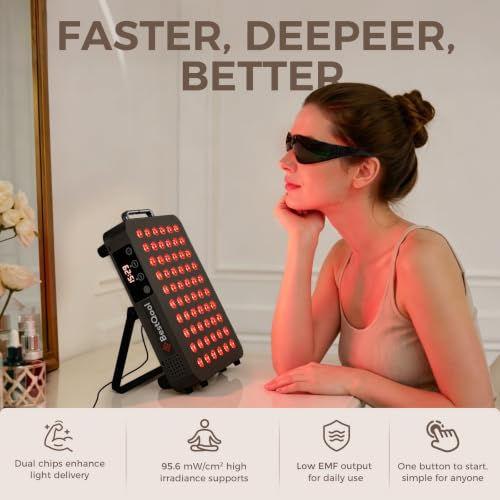
Verdict: The BestQool BQ60 stands out as the most balanced pick for shoppers who want a strong mix of output, flexibility, and everyday usability without jumping to the heaviest premium tier.
- ✓ 660nm red and 850nm near-infrared dual-chip LEDs support face and body use.
- ✓ 3 modes let you choose red light, infrared, or both together.
- ✓ Adjustable U-shaped stand helps with desk, table, or nightstand placement.
- ✓ Flicker-free LEDs and cooling system are designed for steadier daily use.
- ✗ Premium positioning may be more than casual users need.
- ✗ Larger setup than ultra-compact panels.
- ✗ Best results depend on consistent placement and routine.
2. Hooga Red Light Therapy Panel HG200 — Best Compact Tabletop Option


Verdict: The HG200 is a smart choice if you want a smaller, reputable-feeling panel for desk or tabletop sessions and prefer the classic 660nm/850nm pairing.
- ✓ 40 individual 5W LEDs with a 1:1 red and near-infrared ratio.
- ✓ Built-in timer and stand make setup straightforward.
- ✓ Built-in cooling fan helps manage heat during use.
- ✓ Compact size suits desks, side tables, and small rooms.
- ✗ Smaller coverage area than larger panels.
- ✗ Not the most feature-rich option in the lineup.
- ✗ Better for targeted sessions than broad full-body coverage.
3. Red Light Therapy Panel for Face & Body, 2-in-1 Panel with 660nm and 850nm — Best Dual-Use Design

Verdict: This 2-in-1 panel is the best fit for buyers who want red light therapy plus a bright white-light option in one device for year-round home use.
- ✓ Dual-sided design combines red light therapy with up to 10,000 lux of bright white light.
- ✓ 120 LEDs on the red side use 660nm and 850nm wavelengths.
- ✓ 3 red-light modes and 5 brightness levels give you more control.
- ✓ White side offers 3 color temperatures and 5 brightness levels.
- ✗ More of a hybrid device than a pure therapy panel.
- ✗ White-light features may be unnecessary if you only want red light.
- ✗ Dual-purpose design can be less focused than single-purpose panels.
4. Red Light Therapy Panel for Face and Body-600nm/660nm/810nm/850nm/940nm (White) — Best High-Power Multi-Wavelength Pick


Verdict: This is the pick for shoppers who want a more advanced wavelength stack and a more powerful-feeling panel for broader wellness routines.
- ✓ Five wavelengths include 600nm, 660nm, 810nm, 850nm, and 940nm.
- ✓ 70 LEDs and 350W total power support more intensive home sessions.
- ✓ High irradiance is designed for efficient sessions at close range.
- ✓ Includes adjustable stand, timer, carrying handle, eye protection, and hanging kit.
- ✗ More complex than basic red/near-infrared panels.
- ✗ Premium feature set may be overkill for simple facial use.
- ✗ Larger footprint than compact tabletop models.
5. Red Light Therapy Panel for Face and Body-600nm/660nm/810nm/850nm/940nm (Black) — Best Premium Black Finish


Verdict: Performance mirrors the white version, but the black finish may appeal more if you want a darker, more understated look in a home gym or bedroom.
- ✓ Same 5-wavelength setup: 600nm, 660nm, 810nm, 850nm, and 940nm.
- ✓ 70 LEDs and 350W total output for high-powered sessions.
- ✓ Adjustable stand and included accessories support flexible setup.
- ✓ Built-in timer and remote control add convenience.
- ✗ Same premium complexity as the white version.
- ✗ Not the best fit for buyers who want a simple, compact panel.
- ✗ Finish choice does not change the core feature set.
6. SUXIO Red Light Therapy lamp — Best Budget Panel with Higher LED Count


Verdict: If your priority is value, the SUXIO panel offers a lot of LED count and practical mounting flexibility for a lower-cost entry point.
- ✓ 165 LED beads give it a dense-panel feel for the budget tier.
- ✓ 660nm and 850nm wavelengths cover the standard red/infrared pairing.
- ✓ 5 timer settings help structure sessions.
- ✓ Can be hung or placed on the adjustable bracket for flexible use.
- ✗ Budget build may not feel as refined as premium models.
- ✗ Fewer advanced controls than higher-end panels.
- ✗ Best suited to straightforward use rather than advanced customization.
7. Viconor Red Light Therapy for Face and Body — Best Curved-Panel Design


Verdict: This Viconor model is a practical pick if you want a curved panel that aims light more directly while staying easy to move around the house.
- ✓ Curved surface design is meant to focus the light.
- ✓ 120 LEDs with 660nm red and 850nm infrared wavelengths.
- ✓ Can be hung or placed independently for flexible positioning.
- ✓ 180° angle adjustment helps target different areas.
- ✗ Less feature-rich than the top premium options.
- ✗ More basic controls than some competitors.
- ✗ Best for users who value simplicity over advanced settings.
8. Red Light Therapy for Face and Body, Red Infrared Light Therapy Lamp with Stand Led 660nm Red Light-Therapy& 850nm Infrared Light Device for Body — Best Entry-Level Stand Option

Verdict: This is the simplest stand-based option in the roundup, making it a good fit for buyers who want a straightforward starter panel.
- ✓ 120 LEDs with 660nm red and 850nm infrared light.
- ✓ Curved design is intended to focus light on the face and body.
- ✓ Includes hook, 3m power cord, and stand for flexible placement.
- ✓ 180° angle adjustment helps adapt to different use cases.
- ✗ More basic than higher-end competitors.
- ✗ Fewer advanced controls and modes.
- ✗ Best suited to budget-minded buyers who want a simple setup.
How We Chose These Products
To build this roundup, we compared the listed panels using a commercial-intent framework centered on the features shoppers care about most when buying a home red light device. We did not test these products personally; instead, we reviewed published specifications, product architecture, and recurring owner-feedback themes where available.
Selection criteria
- Wavelength coverage: We prioritized the common 660nm red and 850nm near-infrared pairing, plus multi-wavelength options where they added real flexibility.
- Usability: Stand options, timers, brightness control, and mounting flexibility mattered because they affect how often people actually use the panel.
- Face-and-body suitability: We favored products that can reasonably work for targeted facial sessions and broader body placement.
- Output and design: Power, irradiance claims, LED count, and panel shape were weighed for practical session coverage.
- Value by tier: We included budget, mid-range, and premium models so readers can match the device to their budget and routine.
- Buyer feedback patterns: We looked for signs of ease of use, setup convenience, and everyday practicality in documented owner feedback trends.
What matters most when buying
If you want a panel mainly for face sessions, a compact model with a stand and timer is often enough. If you plan to treat larger areas like the back, shoulders, or legs, a stronger panel with better mounting flexibility and broader coverage is usually the smarter buy. For shoppers who want one device that can do more than red light therapy, hybrid models with added lighting features may be worth considering.
Frequently Asked Questions
1. What is the best wavelength for red light therapy panels?
For most shoppers, 660nm red light and 850nm near-infrared light are the most common and practical pairing. Many panels in this roundup use that combination because it suits both face and body use.
2. Can one red light panel work for both face and body?
Yes. A panel can work for both if it has enough coverage, a stand or hanging option, and a wavelength setup that supports general use. Larger or more adjustable panels are usually easier for full-body sessions.
3. Are more LEDs always better?
Not always. LED count matters, but output, wavelength quality, panel design, and how close you can comfortably position the device also matter. A smaller panel with better usability can be more practical than a larger one you rarely use.
4. What features should I look for in a home red light therapy panel?
Look for the wavelength pairing, timer, brightness or mode controls, stand or hanging options, and a size that fits your intended use. If you want body coverage, check whether the panel can be positioned easily at different angles.
5. Which type of buyer should choose a premium red light panel?
Premium panels make the most sense for people who want stronger output, more wavelength options, or a more flexible setup for regular sessions. They are usually best for committed users rather than casual buyers.
Pros
- + 660nm and 850nm are widely used for face and body sessions
- + Multiple options for budget, mid-range, and premium buyers
- + Several models include stands, timers, and flexible mounting
- + Some panels offer extra modes or wavelengths for more control
Cons
- – No hands-on testing was performed
- – Premium models may be more than casual users need
- – Smaller panels provide less coverage than larger units
- – Some hybrid features may be unnecessary for pure red light buyers
Frequently asked questions
- What is the best wavelength for red light therapy panels?
- For most shoppers, 660nm red light and 850nm near-infrared light are the most common and practical pairing. Many panels in this roundup use that combination because it suits both face and body use.
- Can one red light panel work for both face and body?
- Yes. A panel can work for both if it has enough coverage, a stand or hanging option, and a wavelength setup that supports general use. Larger or more adjustable panels are usually easier for full-body sessions.
- Are more LEDs always better?
- Not always. LED count matters, but output, wavelength quality, panel design, and how close you can comfortably position the device also matter. A smaller panel with better usability can be more practical than a larger one you rarely use.
- What features should I look for in a home red light therapy panel?
- Look for the wavelength pairing, timer, brightness or mode controls, stand or hanging options, and a size that fits your intended use. If you want body coverage, check whether the panel can be positioned easily at different angles.
- Which type of buyer should choose a premium red light panel?
- Premium panels make the most sense for people who want stronger output, more wavelength options, or a more flexible setup for regular sessions. They are usually best for committed users rather than casual buyers.
Score breakdown
- value
- 8.0
- usability
- 8.0
- durability
- 7.0
- performance
- 8.0
- buyerFeedback
- 7.0
Get the Full Beauty & Personal Care Buyer's Guide
Join our free newsletter — we'll send our latest Beauty & Personal Care picks, specs and verdicts straight to your inbox.
Free. No spam. Unsubscribe anytime.
Was this review helpful?
Be the first to share your feedback on this review.
Sign in to vote and let us know what you think.
Discussion (0)
No comments yet. Be the first to start the discussion.
Related Reviews

FOREO BEAR 2 Facial Toning Device Review (2026): Specs, Pros & Cons, and Who It's For
If you’re looking for a facial toning device that feels more advanced than a basic microcurrent wand, the FOREO Bear 2 Advanced Microcurrent Facial Device is one of the most talked-about premium options. The challenge is figuring out whether its higher-end features actually justify the investment fo

8 Best Facial Lymphatic Drainage Massagers in 2026 — Top Picks for De-Puffing, Sculpting, and Daily At-Home Use
If you’re searching for the best facial lymphatic drainage massagers 2026 , you probably want one thing: a tool that helps reduce puffiness, supports a more sculpted look, and fits easily into a real skincare routine. The challenge is that some devices are better for gentle daily massage, while othe

5 Best Facial Cryotherapy Devices in 2026 — Cool, Depuff, and Refresh Skin at Home
If your face looks puffy in the morning, feels overheated after skincare, or you want a more refreshed look without complicated routines, facial cryotherapy devices can help. The best facial cryotherapy devices 2026 shoppers are comparing range from simple ice rollers to more advanced LED face masks