


Who this is for: Best for dental buyers, students, and clinic users comparing safer scaling tools for routine, periodontal, or precision cleaning needs.
Check PriceIf you’re trying to understand ultrasonic scaler vs manual scaler safety guide, the main concern is usually simple: which tool is safer for patients, easier to control, and better for different cleaning tasks? The answer depends on technique, training, and the right device features—not just the tool itself. This guide breaks down how each scaler works, when each is used, what safety features matter, and which products are worth considering if you’re comparing options for clinical or educational use.
Related Reviews
How It Works
A manual scaler removes plaque and calculus by direct hand pressure, using a sharpened metal tip to scrape deposits off the tooth surface. Because it relies on the operator’s hand movement, it gives very direct tactile control, which many users value for precision around delicate areas. The tradeoff is that it can take more time and may require more physical effort from the clinician.
An ultrasonic scaler uses rapid vibrations to break up deposits, usually while water cools the tip and flushes away debris. That combination can make scaling faster and can improve visibility when the water spray and suction are managed well. In safety terms, the main advantages are efficiency and reduced hand force, while the main cautions are heat, aerosols, and the need for correct power settings and tip control.
Key Benefits & Use Cases
Why ultrasonic tools are often chosen
Ultrasonic scalers are commonly favored when the goal is efficient removal of heavier buildup, periodontal work, or routine scaling where speed matters. Many models also include adjustable power levels, detachable handpieces, and water control features that help support safer, more comfortable operation when used correctly.
Why manual scalers still matter
Manual scalers remain important for finishing work, fine control, and situations where the operator wants maximum tactile feedback. They can also be useful in settings where simple tools are preferred or where the clinician wants to avoid powered instrumentation for a specific step.
Safety-focused use cases
- Routine prophylaxis and maintenance cleaning
- Periodontal treatment where controlled power settings are important
- Subgingival and supragingival scaling, depending on training and device type
- Educational settings where users are learning technique and safety protocols
- Veterinary or lab workflows that benefit from powered scaling and foot-pedal control
What to Look For When Buying
If you’re comparing products for safety and usability, focus on features that improve control, visibility, hygiene, and workflow. These five criteria matter most:
1. Power control and operating modes
Look for adjustable power or mode selection so the tool can be matched to the task. Lower settings are generally more appropriate for delicate work, while higher settings are better suited to heavier buildup when properly used.
2. Handpiece design and ergonomics
A detachable, lightweight, or easy-to-handle handpiece can reduce fatigue and improve precision. Hard-wired or optical handpieces may add convenience, but the real question is whether the design supports stable, comfortable control.
3. Water delivery and visibility
Water control matters because it helps cool the tip and clear debris. Internal water lines, precision water control, and LED illumination can all make it easier to maintain visibility during treatment.
4. Safety protections and hygiene
For powered scalers, look for electrical protection, water ingress resistance, and autoclavable or detachable components. These features support safer operation and easier infection-control routines.
5. Compatibility and workflow support
Tip compatibility, foot-pedal control, and display clarity all affect how smoothly the device fits into real-world use. A tool that is technically powerful but awkward to operate may create more risk than benefit.
Top Recommended Products
Below are the products from the provided list that best fit this educational comparison. Since this is a research-based guide, the recommendations are based on published specs, feature sets, and documented buyer feedback patterns rather than hands-on testing.
Dental Ultrasonic Scaler, Dual Foot Pedal Control for Lab and Dental Veterinary Clinic (DA-20)


This model stands out for users who want more operational flexibility. Its automatic resonance frequency tracking, triple-mode operation, detachable LED handpiece, and dual foot pedal support make it appealing for clinical workflows where control and visibility matter.
- ✓ Automatic resonance frequency tracking for stable performance
- ✓ Triple-mode operation for scaling, periodontal treatment, and endodontic cleaning
- ✓ Detachable LED handpiece for better illumination
- ✓ Dual foot pedal control for flexible workflow
- ✓ Large water tank or external water source support
- ✗ More feature-rich than a basic entry-level scaler
- ✗ May be more than some simple routine users need
- ✗ Requires familiarity with powered scaling controls
Woodpecker UDS-P Ultrasonic Scaler with Detachable Optical Handpiece
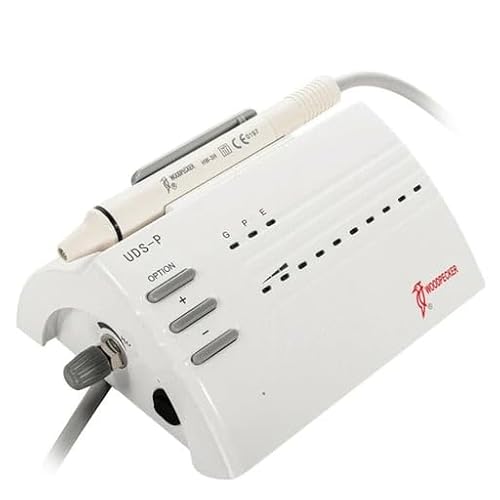


This is the budget-friendly option in the list and a practical pick for buyers who want a safer-feeling feature set without overcomplicating the workflow. Its stable frequency, digital controls, autoclavable handpiece, and electrical protection make it a strong value-oriented choice.
- ✓ Stable frequency with digital controls for precision
- ✓ Adjustable power levels for scaling and endo treatments
- ✓ Detachable, autoclavable handpiece
- ✓ Class II electric shock protection
- ✓ Water ingress resistance for added safety
- ✗ Less premium than higher-end clinical units
- ✗ May not offer the same workflow extras as more advanced models
- ✗ Best suited to buyers who prioritize core function over added features
Medidenta Medi-Scaler Ultrasonic Dental Scaler - Hard-Wired Handpiece Assembly, Precision Water Control for Periodontal and Any Supra/Subgingival or Routine Scaling (30K Model)
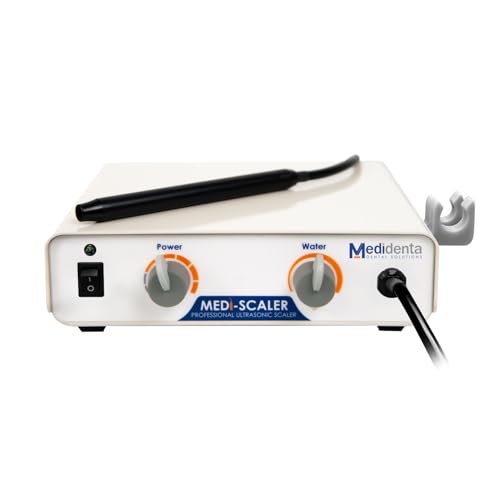


This premium model is aimed at buyers who want a more specialized, confidence-inspiring setup. The hard-wired handpiece, precision water control, broad scaling use cases, and strong warranty coverage make it especially appealing for users who value long-term support and compatibility.
- ✓ Available in 25K and 30K models
- ✓ Designed for periodontal, supra- and subgingival, and routine scaling
- ✓ Compatible with most industry-leading magnetostrictive insert tips
- ✓ Hard-wired handpiece assembly for convenience
- ✓ Strong warranty coverage for circuits and parts
- ✗ Premium positioning may be more than casual users need
- ✗ Hard-wired design may not suit every workflow preference
- ✗ Best for buyers who want a more specialized scaler setup
Dentamerica 880PLUS Scalex 880 Plus Piezo Ultrasonic Scaler Unit and 3 Universal Tips


This is the simplest recommendation in the group and a good fit for buyers who want a straightforward piezo ultrasonic scaler with included tips. It keeps the feature set focused while still covering the essentials for dental use.
- ✓ Piezo ultrasonic scaler unit
- ✓ Includes 3 universal tips
- ✓ Durable and efficient design
- ✓ Suitable for dental use
- ✗ Fewer advanced workflow features than other options
- ✗ Less specialized than the higher-end models
- ✗ Best for buyers who want a simple, functional unit
Common Mistakes to Avoid
- Using the wrong power setting: Too much power can create unnecessary discomfort or reduce control, while too little may make the job inefficient.
- Ignoring tip and handpiece hygiene: Detachable and autoclavable parts are helpful only if they’re cleaned and maintained properly.
- Overlooking water flow: Poor water delivery can reduce visibility and cooling, which affects both safety and performance.
- Assuming powered tools replace technique: Ultrasonic devices still require skill, proper angling, and careful movement.
- Choosing based only on features: The safest choice is the one that matches the user’s skill level, workflow, and cleaning needs.
Frequently Asked Questions
Is an ultrasonic scaler safer than a manual scaler?
Neither is automatically safer in every situation. Ultrasonic scalers can reduce hand force and speed up cleaning, while manual scalers offer more tactile control. Safety depends on training, correct settings, and proper technique.
When should I choose a manual scaler instead of an ultrasonic scaler?
A manual scaler is often preferred when precise tactile feedback is important or when finishing work requires very controlled scraping. It can also be useful when a simple, non-powered tool is the better fit for the task.
What safety features matter most in an ultrasonic scaler?
Look for adjustable power, stable frequency, water control, electrical protection, and autoclavable or detachable components. These features help improve control, hygiene, and day-to-day usability.
Can ultrasonic scalers be used for periodontal and subgingival cleaning?
Many ultrasonic scalers are designed for periodontal and subgingival work, but the exact use depends on the model, tip compatibility, and the operator’s training. Always match the device settings to the procedure.
What is the biggest mistake people make when comparing scaler types?
The biggest mistake is focusing only on speed or price instead of control, hygiene, and safety features. The best tool is the one that supports accurate work and fits the user’s workflow.
Pros
- + Ultrasonic scalers can improve efficiency and reduce hand force
- + Manual scalers offer strong tactile control for finishing work
- + Safety features like autoclavable handpieces and water control matter
- + Adjustable power settings help match the tool to the task
- + Dual foot pedals and LED handpieces improve workflow
Cons
- – Powered scalers require technique and training
- – Too much power can reduce control
- – Poor water flow can affect visibility and cooling
- – Some models are more complex than basic tools
- – Premium options may include features casual users do not need
Frequently asked questions
- Is an ultrasonic scaler safer than a manual scaler?
- Neither is automatically safer in every situation. Ultrasonic scalers can reduce hand force and speed up cleaning, while manual scalers offer more tactile control. Safety depends on training, correct settings, and proper technique.
- When should I choose a manual scaler instead of an ultrasonic scaler?
- A manual scaler is often preferred when precise tactile feedback is important or when finishing work requires very controlled scraping. It can also be useful when a simple, non-powered tool is the better fit for the task.
- What safety features matter most in an ultrasonic scaler?
- Look for adjustable power, stable frequency, water control, electrical protection, and autoclavable or detachable components. These features help improve control, hygiene, and day-to-day usability.
- Can ultrasonic scalers be used for periodontal and subgingival cleaning?
- Many ultrasonic scalers are designed for periodontal and subgingival work, but the exact use depends on the model, tip compatibility, and the operator’s training. Always match the device settings to the procedure.
- What is the biggest mistake people make when comparing scaler types?
- The biggest mistake is focusing only on speed or price instead of control, hygiene, and safety features. The best tool is the one that supports accurate work and fits the user’s workflow.
Get the Full Beauty & Personal Care Buyer's Guide
Join our free newsletter — we'll send our latest Beauty & Personal Care picks, specs and verdicts straight to your inbox.
Free. No spam. Unsubscribe anytime.
Was this review helpful?
Be the first to share your feedback on this review.
Sign in to vote and let us know what you think.
Discussion (0)
No comments yet. Be the first to start the discussion.
Related Reviews
How to Choose the Best Home Intraoral Camera in 2026: Complete Buying Guide
If you’re trying to figure out how to choose a home intraoral camera , the biggest challenge is separating useful features from marketing noise. The right camera can make it easier to spot tooth discoloration, gum issues, broken fillings, and plaque buildup before a dental visit. The most common mis

3 Best Rechargeable Interdental Cleaners in 2026 — Easier Flossing for Braces, Travel, and Sensitive Gums
If string floss feels slow, awkward, or hard to keep up with, a rechargeable interdental cleaner can make daily oral care much easier. The best rechargeable interdental cleaners 2026 shoppers want usually combine portable design, strong cleaning action, and simple charging so you can stick with the

Burst Pro 2.0 Sonic Toothbrush for Adults (White) Review (2026): Specs, Pros & Cons, and Who It's For
Check Price on Amazon →