

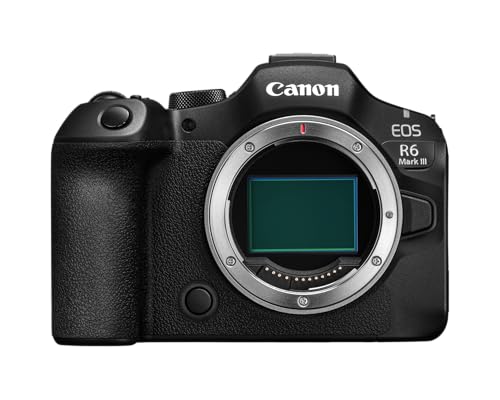
Who this is for: Best for photographers and hybrid creators who want a premium full-frame body with strong autofocus, stabilization, and video.
At a Glance
| Category | Sony a7 V | Canon R6 Mark III |
|---|---|---|
| Sensor | 33.0MP full-frame, partially stacked CMOS | 32.5MP full-frame CMOS |
| Burst speed | Up to 30 fps with AF/AE tracking | Up to 40 fps with pre-continuous shooting |
| Autofocus | AI-based Real-time Recognition AF and tracking | Dual Pixel CMOS AF II with people, animal, vehicle detection |
| IBIS | Up to 7.5 stops center / 6.5 stops peripheral | Up to 8.5 stops center / 7.5 stops peripheral |
| Video | 4K 120p | Not specified in provided specs |
| Storage | Not specified in provided specs | Dual slots: CFexpress Type B + UHS-II SD |
Design
Winner: Canon R6 Mark III

The Canon body gets the nod here because its feature set feels a little more straightforward for photographers who want a familiar, workhorse-style full-frame camera. The dual-card setup also makes it more confidence-inspiring for paid shoots, events, and travel sessions where backup storage matters.
Related Reviews
The Sony a7 V is still a premium body with a very strong spec sheet, but the Canon’s practical layout advantages and dual-slot design make it the better pick for many buyers who prioritize reliability and workflow simplicity.
✓ Pros
- Dual card slots with CFexpress Type B and UHS-II SD
- Up to 8.5 stops of coordinated IBIS
- Up to 40 fps burst shooting
- People, animal, and vehicle detection AF
✗ Cons
- Video specs were not fully provided in the product data
- Less advanced autofocus language than Sony’s AI-based system
- Only slightly cheaper than the Sony
Performance
Winner: Sony a7 V

This is where Sony pulls ahead. The a7 V’s partially stacked 33.0MP sensor, BIONZ XR2 processor, and AI-based Real-time Recognition AF point to a more advanced performance platform overall. Sony also claims blackout-free bursts up to 30 fps with AF/AE tracking and 4K 120p video, which makes it especially compelling for hybrid creators.
Canon counters with a faster burst rate on paper at up to 40 fps, but because the provided specs don’t go as deep on video and processing advantages, the Sony feels like the stronger all-round performance camera for most commercial buyers.
✓ Pros
- Partially stacked sensor for faster readout
- Up to 30 fps blackout-free bursts with AF/AE tracking
- 4K 120p video capability
- AI-based Real-time Recognition AF and tracking
- Up to 16 stops of dynamic range
✗ Cons
- Burst rate is lower than Canon’s headline number
- Premium pricing
- Some workflow details depend on Sony ecosystem familiarity
Autofocus
Winner: Sony a7 V
Sony’s autofocus system wins this round because the company’s AI processing is clearly more ambitious on the provided specs. The a7 V adds human pose estimation, improved recognition, and stable tracking that should appeal to shooters who work with unpredictable subjects.
Canon’s Dual Pixel CMOS AF II is still excellent on paper, especially with people, animal, and vehicle detection plus Register People Priority. But when you’re comparing the two as a commercial-investigation purchase, Sony’s AI-based subject recognition appears more advanced and more future-facing.
✓ Pros
- AI-based Real-time Recognition AF
- Real-time Tracking support
- Human pose estimation for better subject recognition
- Multiple-subject recognition
✗ Cons
- More advanced AF features may be overkill for casual users
- Learning curve can be higher if you’re new to Sony menus
Stabilization and Handheld Use
Winner: Canon R6 Mark III
Canon takes the win for stabilization because its quoted IBIS numbers are stronger: up to 8.5 stops in the center and 7.5 stops on the periphery. That gives it a slight edge for handheld stills, slower shutter work, and casual run-and-gun shooting.
Sony’s stabilization is also excellent, especially with up to 7.5-step central and 6.5-step peripheral correction, but Canon’s higher figures make it the more attractive choice if you often shoot without a tripod or gimbal.
✓ Pros
- Up to 8.5 stops of center stabilization
- Strong peripheral correction at 7.5 stops
- Great for handheld shooting and travel
✗ Cons
- Doesn’t match Sony’s AI-driven performance story
- Less emphasis on hybrid video features in the provided specs
Value
Winner: Canon R6 Mark III
The Canon is more affordable than the Sony while still delivering a very strong spec sheet: 32.5MP, 40 fps shooting, high-end IBIS, and dual card slots. That makes it a good value for buyers who want premium performance without opting for the pricier Sony.
The Sony’s extra cost is easier to justify if you care deeply about its AI autofocus, 4K 120p video, and partially stacked sensor. But on pure value-for-money, Canon wins by offering a slightly lower price and a very complete stills-focused package.
✓ Pros
- Lower price than the Sony
- Very strong stills feature set
- Dual-card workflow adds practical value
✗ Cons
- Only modestly cheaper
- Less compelling for hybrid creators than the Sony
Battery and Durability
Winner: Canon R6 Mark III
We don’t have full battery-life numbers in the supplied specs, so this category comes down to practical durability cues. Canon’s dual-card slots are a big plus for real-world shooting security, and the body’s overall design reads as the more field-ready option for many photographers.
Sony’s body is clearly capable and refined, but because the available information is more focused on sensor and AI advances, the Canon feels like the safer bet for long workdays where redundancy matters.
✓ Pros
- Dual-slot storage for added redundancy
- Strong in-body stabilization for handheld durability
- Built for demanding stills workflows
✗ Cons
- Battery life not specified in the provided data
- No clear durability advantage from the available specs
Sony a7 V Is the Better Choice If…
- You want the stronger all-around performance camera.
- You care about AI-based autofocus and subject tracking.
- You shoot hybrid photo/video and want 4K 120p.
- You value a partially stacked sensor and faster readout.
- You want the more future-facing feature set overall.
Canon R6 Mark III Is the Better Choice If…
- You want the better value at a slightly lower price.
- You prioritize stronger IBIS for handheld shooting.
- You like the security of dual card slots.
- You shoot fast action and want the 40 fps headline burst rate.
- You prefer a very capable full-frame body with a practical workflow.
Our Final Verdict
For most buyers comparing sony a7 v vs canon r6 mark iii, the Sony Alpha a7 V Full-Frame Mirrorless Camera Body AI AF 30fps is the better overall pick. It offers the more advanced sensor design, stronger AI autofocus story, and more impressive hybrid video capabilities, which makes it the smarter long-term choice for creators who shoot both stills and motion.
That said, the Canon EOS R6 Mark III Body, Full-Frame Mirrorless Camera is a very close runner-up and arguably the better value for photographers who care most about stabilization, burst speed, and dual-card reliability.
If you want the most capable all-around mirrorless body in this matchup, choose Sony. If you want a slightly cheaper, highly practical workhorse, choose Canon.
Frequently Asked Questions
1. Which is better, Sony a7 V or Canon R6 Mark III?
The Sony a7 V is the better overall choice for most buyers because of its more advanced AI autofocus, partially stacked sensor, and 4K 120p video support.
2. Is the Canon R6 Mark III better for action photography?
It can be, especially because it offers up to 40 fps shooting and strong stabilization, which are both useful for sports and wildlife.
3. Does the Sony a7 V have better autofocus than the Canon R6 Mark III?
Based on the provided specs, yes. Sony’s AI-based Real-time Recognition AF and human pose estimation give it the edge in autofocus sophistication.
4. Which camera is better value for the money?
The Canon R6 Mark III is the better value because it costs slightly less while still offering a very strong feature set for stills shooters.
5. Which camera is better for video?
The Sony a7 V is the better video option from the available specs, thanks to its 4K 120p capability and stronger hybrid-focused feature set.
Pros
- + Sony AI autofocus and tracking
- + Sony 4K 120p hybrid video
- + Canon stronger IBIS
- + Canon dual card slots
- + Canon lower price
Cons
- – Sony costs more
- – Canon video specs not fully provided
- – Sony burst rate lower than Canon
Frequently asked questions
- Which is better, Sony a7 V or Canon R6 Mark III?
- The Sony a7 V is the better overall choice for most buyers because of its more advanced AI autofocus, partially stacked sensor, and 4K 120p video support.
- Is the Canon R6 Mark III better for action photography?
- It can be, especially because it offers up to 40 fps shooting and strong stabilization, which are both useful for sports and wildlife.
- Does the Sony a7 V have better autofocus than the Canon R6 Mark III?
- Based on the provided specs, yes. Sony’s AI-based Real-time Recognition AF and human pose estimation give it the edge in autofocus sophistication.
- Which camera is better value for the money?
- The Canon R6 Mark III is the better value because it costs slightly less while still offering a very strong feature set for stills shooters.
- Which camera is better for video?
- The Sony a7 V is the better video option from the available specs, thanks to its 4K 120p capability and stronger hybrid-focused feature set.
Score breakdown
- value
- 8.6
- usability
- 8.8
- durability
- 8.7
- performance
- 9.3
- buyerFeedback
- 8.9
Get the Full Tech Buyer's Guide
Join our free newsletter — we'll send our latest Tech picks, specs and verdicts straight to your inbox.
Free. No spam. Unsubscribe anytime.
Was this review helpful?
Be the first to share your feedback on this review.
Sign in to vote and let us know what you think.
Discussion (0)
No comments yet. Be the first to start the discussion.
Related Reviews

8 Best Compact Telephoto Bridge Cameras for Travel in 2026 — Big Zoom, Small Travel Burden
If you want a camera that can reach faraway subjects without hauling a heavy kit, the best compact telephoto bridge cameras for travel are the sweet spot. They give you serious zoom, built-in stabilization, and simple all-in-one handling for trips, wildlife, sports, and sightseeing. In this guide, w
 8.0
8.0ROVE Dual Dash Cam Review: 4 Listing Claims Checked
The ROVE Dual Dash Cam is a front-and-rear car camera with GPS, WiFi, a 3" screen, and parking mode features. We checked 4 promises from the listing against the listing’s own title, bullets, spec callouts, and images. A couple of claims hold up cleanly, while others come with important fine print.

GoPro HERO12 Black Review (2026): Specs, Pros & Cons, and Who It’s For
Check Price on Amazon →