


Who this is for: Best for vinyl beginners and turntable owners who need to connect a record player to speakers or amps with proper volume and sound.
Check PriceWhat is a Phono Preamp? A Complete 2026 Guide
If you’re searching for phono preamp explained do i need one, you’re probably trying to figure out why your turntable sounds too quiet, thin, or even completely wrong when plugged into speakers. A phono preamp is the missing link for many vinyl setups because it boosts the tiny signal from a record player and corrects how that signal is shaped. In this guide, you’ll learn what it does, how to tell whether you need one, and which models make sense for different budgets and setups.
Related Reviews
How It Works
A turntable cartridge produces a very small audio signal, far too weak to plug directly into most speakers, receivers, or audio interfaces. A phono preamp solves that by applying two jobs at once: it amplifies the signal to line level and applies RIAA equalization, which restores the bass and treble balance that was intentionally altered when the record was cut.
Why is that equalization needed? Vinyl records are mastered with reduced bass and boosted treble so the grooves can fit more music and avoid distortion. The phono preamp reverses that curve so the playback sounds natural again.
There are two common cartridge types to know:
- MM (Moving Magnet) cartridges are the most common and usually need an MM-capable phono preamp.
- MC (Moving Coil) cartridges output an even smaller signal and need extra gain or a preamp specifically built for MC support.
So, do you need one? If your turntable does not have a built-in phono stage and your receiver, powered speakers, or audio interface doesn’t include a PHONO input, then yes, you almost certainly need a phono preamp. If your turntable already has a switchable preamp, you may not need an external one unless you want better sound or more flexibility.
Key Benefits & Use Cases
1) Restores proper volume and tone
The biggest benefit is simple: a phono preamp makes your records loud enough to listen to and restores the intended tonal balance. Without it, music often sounds weak, distorted, or unusually bright.
2) Lets you connect a turntable to modern gear
Many powered speakers and soundbars don’t have a dedicated phono input. A phono preamp lets you connect your turntable to standard RCA line inputs, active speakers, headphone amps, and some recording setups.
3) Improves vinyl listening flexibility
Some models add headphone outputs, volume control, or tone adjustment, which can be useful in small spaces or desktop systems. That makes them practical for apartment listening, late-night sessions, or compact audio setups.
4) Supports system upgrades
If you start with a basic turntable and later upgrade speakers or cartridges, an external phono preamp can be the component that keeps everything compatible and sounding clean.
5) Helps avoid common beginner mistakes
People often assume all audio inputs are the same. A phono preamp prevents the classic “why does my record sound so quiet and tinny?” problem that happens when a turntable is plugged into a line-level input without the proper stage.
What to Look For When Buying
1) Cartridge compatibility
Check whether your turntable uses MM, MC, or both. If you only have an MM cartridge, an MM-only phono preamp can be perfectly fine and often costs less.
2) Gain level
Gain determines how much the tiny cartridge signal is boosted. MM setups commonly need around 40–46 dB of gain, while MC cartridges usually need more. Too little gain sounds quiet; too much can cause distortion.
3) Noise and distortion performance
Look for low THD+N, good signal-to-noise ratio, and positive owner feedback about background silence. A phono preamp should amplify the signal without adding hiss, hum, or harshness.
4) Inputs and outputs
Think about how you’ll use it. Some units offer RCA in/out only, while others add headphone outputs, volume control, or multiple output options for speakers and headphones.
5) Build quality and setup convenience
Compact metal cases, solid grounding, and simple controls matter more than they may seem. A well-built unit is easier to place near a turntable and less likely to pick up interference.
Top Recommended Products
Below are the products from the provided list, with the first mentions linked for easy shopping. These are research-based recommendations built from published specs, features, and buyer feedback patterns rather than hands-on testing.
S.M.S.L PH-1 Phono Preamp for MM Turntable, MM Phono Amp Preamplifier for Phonograph Record Player Active Speakers, RCA/6.35mm Headphone Amplifier Pre-amp with Gain 46dB DC5V Power (Prime)


This MM-focused phono preamp is a strong fit if you want a simple, low-noise solution for a standard turntable setup. The 46 dB gain, headphone output, and compact footprint make it especially appealing for desktop or small-room listening.
- ✓ Designed specifically for MM cartridges
- ✓ 46 dB gain with low-noise power processing
- ✓ Integrated 6.35 mm headphone amplifier
- ✓ Compact and easy to place near a turntable
- ✓ Simple controls and grounding connection
- ✗ MM only, so it won’t suit MC-only users
- ✗ Best for basic turntable systems rather than advanced cartridge matching
S.M.S.L PH-1 MM Phono Preamp,46dB Gain/Low Distortion,CNC-Made, Headphone Amp Integrated,for Turntable Setup (Prime)


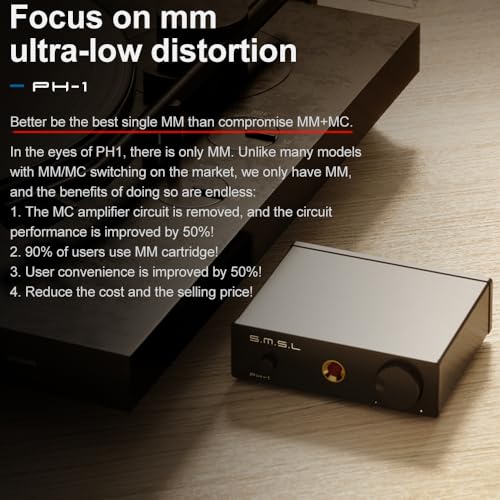
This version of the PH-1 is aimed at listeners who want a compact, well-built MM preamp with strong measured performance. The CNC-machined body and flexible outputs make it a practical upgrade for beginners and hobbyists alike.
- ✓ 46 dB gain tuned for mainstream MM cartridges
- ✓ Low distortion performance based on published specs
- ✓ CNC-machined compact body
- ✓ Headphone amp adds flexibility for private listening
- ✓ Suitable for both home and studio vinyl setups
- ✗ MM-only design limits cartridge compatibility
- ✗ More features than some beginners may need
S.M.S.L PH-1 Mini Phono Preamp, Stereo Preamplifier with RCA/6.35mm Headphone Output, Preamp for MM Turntable Phonograph Record Player with DC 5V Power Supply (Prime)


This mini version makes sense if you want the same core MM phono preamp idea in a very compact chassis. It is particularly appealing for small shelves, desktop systems, and users who want a tidy setup with headphone output included.
- ✓ MM-focused design with 46 dB gain
- ✓ Very compact, palm-sized body
- ✓ Integrated headphone output and volume control
- ✓ Stable DC 5V power supply
- ✓ Easy to wire in a simple turntable chain
- ✗ Not suited to MC cartridges
- ✗ Small size may mean fewer advanced controls
T14 MM MC cart Turntable Phono RIAA Preamp preamplifier BASS Treble Adjustment + Headphone Amplifier (Prime)


The T14 stands out because it supports both MM and MC cartridges, which gives it broader compatibility than the MM-only options above. If you want tone controls and a lower price, it is the most flexible budget pick in this list.
- ✓ Supports both MM and MC cartridges
- ✓ Bass and treble adjustment included
- ✓ Full metal casing and compact form factor
- ✓ Headphone amplifier built in
- ✓ Lowest price in this roundup
- ✗ Fewer published performance details than the S.M.S.L models
- ✗ Tone controls may not be necessary for purist listeners
Common Mistakes to Avoid
Plugging a turntable into the wrong input
One of the most common mistakes is connecting a turntable directly to a line input without a phono stage. That usually causes very low volume and thin sound because the signal is not being amplified or equalized properly.
Buying the wrong cartridge type support
MM and MC are not interchangeable in every setup. If your cartridge is MC, an MM-only preamp may not provide enough gain or the correct loading.
Ignoring grounding
Hum and buzz often come from poor grounding rather than a bad turntable. Always check the ground wire and cable connections before blaming the phono preamp.
Overlooking built-in preamps
Some turntables already have a switchable phono preamp. If you use the built-in stage while also sending the signal into another phono input, the sound can become distorted and overly loud.
Assuming expensive always means better
For many MM turntable owners, a well-designed budget phono preamp is enough. The best choice is the one that matches your cartridge, your speakers, and your listening habits.
Frequently Asked Questions
Do I need a phono preamp for my turntable?
Yes, if your turntable does not have a built-in phono stage and your amplifier, receiver, or powered speakers do not have a PHONO input. Without one, the record will usually sound too quiet and unbalanced.
What does a phono preamp actually do?
It boosts the tiny signal from a turntable cartridge to line level and applies RIAA equalization so the music sounds natural. That correction restores the bass and treble balance used when the record was mastered.
What is the difference between MM and MC phono preamps?
MM preamps are designed for moving magnet cartridges, which are the most common. MC-capable preamps add more gain and are built for lower-output moving coil cartridges.
Can I use a phono preamp with powered speakers?
Yes. In fact, that is one of the most common uses. The phono preamp lets you connect the turntable to standard line-level inputs on powered speakers.
How do I know if my turntable already has a preamp?
Check the turntable’s manual or look for a switch labeled PHONO/LINE. If it has a line output, it may already include a preamp, and you should avoid stacking another one unless the setup is designed for it.
Pros
- + Restores proper volume and tone
- + Connects turntables to modern speakers and amps
- + Helps avoid beginner setup mistakes
- + Some models add headphone outputs and volume control
Cons
- – MM-only models won’t suit MC cartridges
- – Wrong input or double preamping can cause distortion
- – Grounding issues can still create hum
Frequently asked questions
- Do I need a phono preamp for my turntable?
- Yes, if your turntable does not have a built-in phono stage and your amplifier, receiver, or powered speakers do not have a PHONO input. Without one, the record will usually sound too quiet and unbalanced.
- What does a phono preamp actually do?
- It boosts the tiny signal from a turntable cartridge to line level and applies RIAA equalization so the music sounds natural. That correction restores the bass and treble balance used when the record was mastered.
- What is the difference between MM and MC phono preamps?
- MM preamps are designed for moving magnet cartridges, which are the most common. MC-capable preamps add more gain and are built for lower-output moving coil cartridges.
- Can I use a phono preamp with powered speakers?
- Yes. In fact, that is one of the most common uses. The phono preamp lets you connect the turntable to standard line-level inputs on powered speakers.
- How do I know if my turntable already has a preamp?
- Check the turntable’s manual or look for a switch labeled PHONO/LINE. If it has a line output, it may already include a preamp, and you should avoid stacking another one unless the setup is designed for it.
Get the Full Tech Buyer's Guide
Join our free newsletter — we'll send our latest Tech picks, specs and verdicts straight to your inbox.
Free. No spam. Unsubscribe anytime.
Was this review helpful?
Be the first to share your feedback on this review.
Sign in to vote and let us know what you think.
Discussion (0)
No comments yet. Be the first to start the discussion.
Related Reviews
 8.0
8.0Apple AirPods Pro 3 Review: 4 Listing Claims Checked
Apple AirPods Pro 3 are wireless earbuds with active noise cancellation, Live Translation, heart rate sensing, and USB-C charging in the listing. We checked 4 promises from the listing against the listing’s own title, bullets, spec details, and images. Some claims are clearly shown, while others com

3 Best Noise Cancelling Headphones for Airplane Travel in 2026 — Quieter Flights, Longer Battery, Better Value
If cabin noise ruins your ability to sleep, watch movies, or simply relax on a flight, the right headphones can make a huge difference. This guide rounds up the best noise cancelling headphones for airplane travel based on published specs, feature sets, and documented owner feedback patterns—not han

7 Best DACs for Headphones in 2026 — Cleaner Sound, Better Power, and Easier Desktop Listening
If your headphones sound flat, quiet, or harsh from a laptop, controller, or motherboard jack, a good DAC can make a huge difference. The best DACs for headphones don’t just improve clarity — they also give you better volume control, stronger amplification, and the right inputs for PC, console, or m