

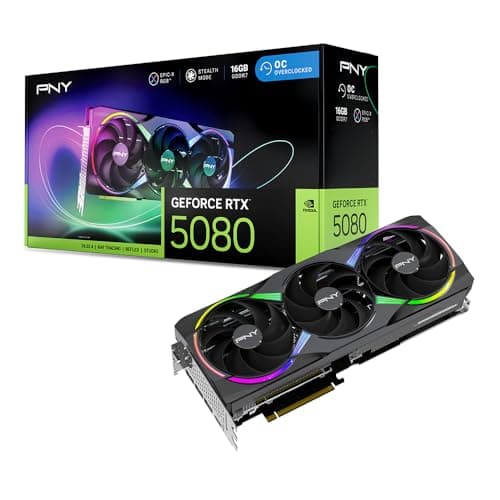
RTX 5080 vs RTX 5070 Ti (2026): Which Should You Actually Buy?
At a Glance
| Spec | RTX 5080 | RTX 5070 Ti |
|---|---|---|
| Product | PNY NVIDIA GeForce RTX™ 5080 Epic-X™ ARGB OC Triple Fan | PNY GeForce RTX 5070 Ti Epic-X ARGB OC Triple Fan |
| VRAM | 16GB GDDR7 | 16GB GDDR7 |
| Memory Bus | 256-bit | 256-bit |
| Boost Clock | 2775 MHz | 2640 MHz |
| Architecture | NVIDIA Blackwell | NVIDIA Blackwell |
| Outputs | HDMI / DP 2.1 | HDMI / DP 2.1 |
| MSRP / Listed Price | 12% OFF — Was $1499.99 $1319.99 ✓ Prime |
$979.99 ✓ Prime |
| Best For | Maximum 4K gaming, higher-end creative work, more headroom | High-refresh 1440p, strong 4K entry, better value |
Design
Winner: RTX 5070 Ti
The design story here is basically a tie on paper, but the PNY GeForce RTX 5070 Ti Epic-X ARGB OC Triple Fan gets the nod for being the more practical buy. Both cards use a triple-fan cooler and both are built on the same Blackwell platform with PCIe 5.0 and modern display outputs, so neither feels dated.
Related Reviews
The reason the 5070 Ti wins this category is simple: it delivers the same premium look and feature set without pushing you into a larger budget tier. If you’re building a clean gaming PC with RGB and want a card that looks high-end without paying top-shelf pricing, the 5070 Ti is the easier fit.
RTX 5080 design note: the PNY NVIDIA GeForce RTX™ 5080 Epic-X™ ARGB OC Triple Fan is still the more premium product overall, and its 2.99-slot cooler suggests stronger thermal ambition. But unless you specifically need the higher-tier card, the physical design advantage doesn’t outweigh the value edge of the 5070 Ti.
Verdict: RTX 5070 Ti wins Design
Performance
Winner: RTX 5080
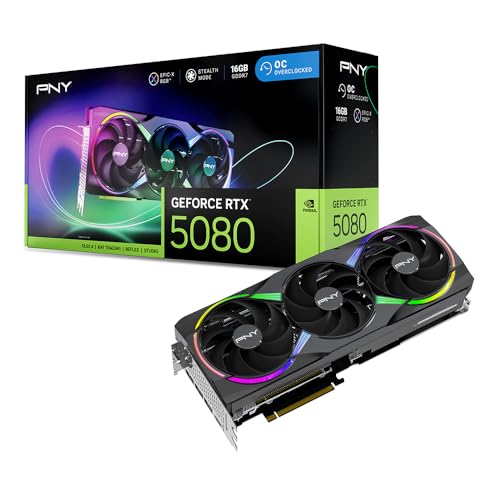
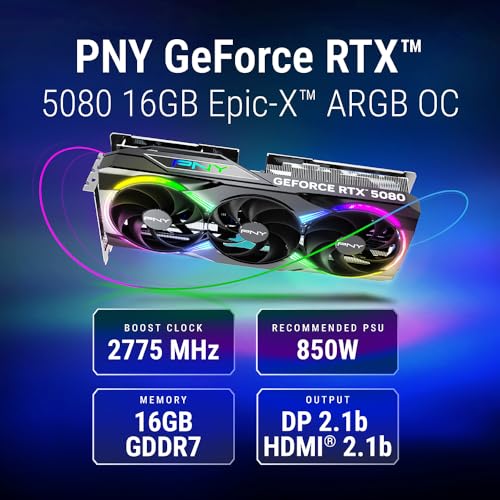

This is the category that decides the whole comparison, and the PNY NVIDIA GeForce RTX™ 5080 Epic-X™ ARGB OC Triple Fan is the clear winner. Its 2775 MHz boost clock is higher than the 5070 Ti’s 2640 MHz boost, and that extra headroom matters when you’re chasing smoother frame rates at higher resolutions or pushing demanding creative workloads.
Both cards share 16GB of GDDR7 memory, a 256-bit bus, DLSS 4, Reflex 2, RTX AI PC features, and NVIDIA Studio support. That means the real difference is not feature access—it’s raw performance and the amount of headroom you get in demanding games and apps. If you want the stronger card for 4K gaming, ray tracing, or heavier editing sessions, the 5080 is the one to choose.
The 5070 Ti is still very fast, and for many 1440p players it will be more than enough. But if you’re comparing these two directly, the 5080’s higher-tier positioning and faster boost clock make it the better performance pick.
Verdict: RTX 5080 wins Performance
Value
Winner: RTX 5070 Ti
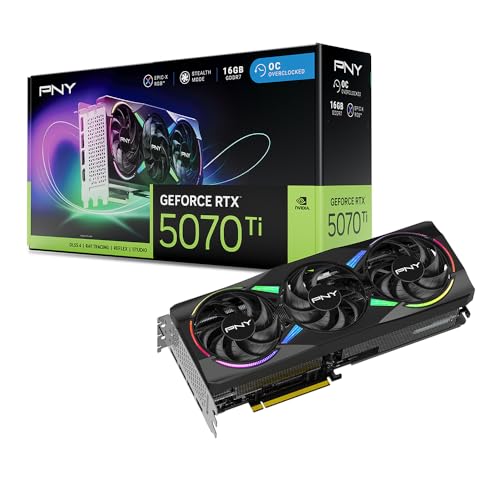


Value is where the PNY GeForce RTX 5070 Ti Epic-X ARGB OC Triple Fan shines. At $979.99, it’s significantly cheaper than the 5080 while still offering 16GB of GDDR7, the same 256-bit bus, PCIe 5.0, HDMI/DP 2.1, DLSS 4, Reflex, and NVIDIA Studio support.
That makes the 5070 Ti the smarter purchase for buyers who want premium RTX 50-series features without paying the steep premium of the 5080. In practical terms, it gives you most of the modern platform benefits and enough horsepower for serious gaming, while keeping your total PC budget more reasonable.
The 5080 may be the faster card, but the price jump is large enough that many buyers will get a better overall experience by putting the savings into a better CPU, more storage, or a higher-end monitor.
Verdict: RTX 5070 Ti wins Value
Battery/Durability
Winner: RTX 5080
For desktop GPUs, “battery” isn’t relevant, so the real question is durability, thermals, and long-term headroom. The PNY NVIDIA GeForce RTX™ 5080 Epic-X™ ARGB OC Triple Fan gets the edge here because its 2.99-slot cooler and higher-end positioning suggest more thermal margin under sustained loads.
That matters if you plan to keep the card for years, run long gaming sessions, or use it for rendering and AI-assisted workloads where the GPU stays loaded for extended periods. More cooling headroom can help preserve performance consistency over time, especially in warmer cases or smaller airflow-constrained builds.
The 5070 Ti is still a solid, modern card with the same Blackwell platform and triple-fan design, so it is not fragile or underbuilt. But if we’re talking about the better long-term durability play, the 5080’s stronger cooling and higher-tier build intent make it the safer bet.
Verdict: RTX 5080 wins Durability / Long-Term Headroom
Features and AI Tools
Winner: Tie
On features, this matchup is essentially a draw. Both cards support DLSS 4, Reflex, RTX AI PC capabilities, and NVIDIA Studio acceleration. That means both are excellent choices if you care about AI-enhanced gaming, low-latency competitive play, and creative workflows like video editing or 3D rendering.
The 5080’s product listing emphasizes the newer DLSS 4 suite with Multi Frame Generation and improved Ray Reconstruction and Super Resolution, but the 5070 Ti also benefits from the same core Blackwell-era feature stack. In the real world, both cards deliver the feature set most buyers actually want from a modern NVIDIA GPU.
Verdict: Tie
RTX 5080 Is the Better Choice If…
- You want the faster GPU and plan to game at higher settings or higher resolutions.
- You care about stronger long-term headroom for demanding titles and creative workloads.
- You want the better pick for 4K gaming and heavier ray tracing use.
- You’re willing to pay extra for a more premium tier of performance.
- You want the stronger cooling and durability story for long sessions.
RTX 5070 Ti Is the Better Choice If…
- You want the best overall value in this head-to-head.
- You’re building a high-end 1440p gaming PC and don’t need the extra cost of the 5080.
- You want to keep more money for the rest of your build.
- You still want 16GB GDDR7, DLSS 4, Reflex, and NVIDIA Studio support.
- You prefer the smarter purchase over the absolute fastest option.
Our Final Verdict
The RTX 5080 is the better overall GPU in this comparison because it delivers the stronger performance, better long-term headroom, and a more premium cooling setup. If your goal is to buy once and get the fastest experience between these two PNY cards, the 5080 is the one to beat.
That said, the RTX 5070 Ti is the better value buy by a wide margin. It keeps the same modern RTX 50-series feature set, the same 16GB GDDR7 capacity, and the same Blackwell platform benefits, while costing far less. For most gamers, that makes it the more sensible purchase.
If you want the best performance, choose the PNY NVIDIA GeForce RTX™ 5080 Epic-X™ ARGB OC Triple Fan.
If you want the smarter value pick, choose the PNY GeForce RTX 5070 Ti Epic-X ARGB OC Triple Fan.
Frequently Asked Questions
Is the RTX 5080 worth it over the RTX 5070 Ti?
Yes, if you want the faster card and plan to use it for 4K gaming, heavy ray tracing, or demanding creative work. If you care more about value, the 5070 Ti is usually the smarter buy.
Does the RTX 5070 Ti have enough performance for 1440p gaming?
Absolutely. The RTX 5070 Ti is a strong choice for high-refresh 1440p gaming and still offers modern features like DLSS 4 and Reflex.
Do both cards support DLSS 4?
Yes. Both GPUs support DLSS 4, which helps boost FPS, improve image quality, and reduce latency in supported games.
Which card is better for content creation?
The RTX 5080 is better for heavier content creation workloads because it offers more performance headroom, but both cards support NVIDIA Studio features and AI-assisted workflows.
Which one is the better value for most buyers?
The RTX 5070 Ti is the better value for most buyers because it delivers a strong feature set and high-end gaming performance at a much lower price.
Frequently asked questions
- Is the RTX 5080 worth it over the RTX 5070 Ti?
- Yes, if you want the faster card and plan to use it for 4K gaming, heavy ray tracing, or demanding creative work. If you care more about value, the 5070 Ti is usually the smarter buy. Does the RTX 5070 Ti have enough performance for 1440p gaming?
- Does the RTX 5070 Ti have enough performance for 1440p gaming?
- Absolutely. The RTX 5070 Ti is a strong choice for high-refresh 1440p gaming and still offers modern features like DLSS 4 and Reflex. Do both cards support DLSS 4?
- Do both cards support DLSS 4?
- Yes. Both GPUs support DLSS 4, which helps boost FPS, improve image quality, and reduce latency in supported games. Which card is better for content creation?
- Which card is better for content creation?
- The RTX 5080 is better for heavier content creation workloads because it offers more performance headroom, but both cards support NVIDIA Studio features and AI-assisted workflows. Which one is the better value for most buyers?
- Which one is the better value for most buyers?
- The RTX 5070 Ti is the better value for most buyers because it delivers a strong feature set and high-end gaming performance at a much lower price.
Get the Full Tech Buyer's Guide
Join our free newsletter — we'll send our latest Tech picks, specs and verdicts straight to your inbox.
Free. No spam. Unsubscribe anytime.
Was this review helpful?
Be the first to share your feedback on this review.
Sign in to vote and let us know what you think.
Discussion (0)
No comments yet. Be the first to start the discussion.
Related Reviews
1 Best PSU 2026 — Reliable Power for Budget PC Builds
If you’re searching for the best PSU 2026 , you probably want a power supply that is safe, efficient, and affordable without overpaying for features you won’t use. The challenge is that PSU shopping is confusing fast: wattage, efficiency ratings, protections, and connector support all matter. This r
8 Best 32GB RAM Kits in 2026 — Faster Gaming, Smoother Multitasking, and Better Value
If you’re shopping for the best 32GB RAM kits 2026, the biggest challenge is sorting out which kits actually fit your PC, your motherboard, and your budget. Some buyers need a fast DDR5 2x16GB kit for gaming, while others just want a reliable DDR4 upgrade that won’t overcomplicate installation. This

8 Best DDR5 6000 RAM in 2026 — Fastest Stable Picks for Gaming, Workloads, and Easy XMP/EXPO Tuning
If you’re shopping for the best DDR5 6000 RAM, you’re probably trying to balance speed, stability, and compatibility without overpaying for specs you won’t feel. DDR5 6000MHz has become the sweet spot for many modern AMD and Intel builds, especially for gamers and creators who want strong performanc