

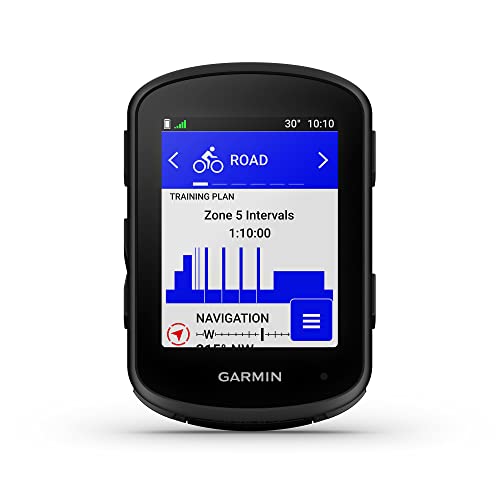
Who this is for: Best for serious cyclists who need advanced navigation, training tools, and climb data in a compact GPS computer.
Check PriceKey Specifications
| Spec | Details |
|---|---|
| Product | Garmin Edge 840, Compact GPS Cycling Computer |
| Controls | Touchscreen and button control |
| Navigation | Advanced GPS cycling computer with enhanced planning and route guidance |
| GNSS | Multi-band GNSS technology |
| Battery Life | Up to 26 hours in demanding use cases; up to 32 hours in battery saver mode |
| Training Tools | Daily suggested workouts, training prompts, and adaptive coaching with compatible sensors |
| Climbing Feature | ClimbPro ascent planner available on every ride, no course required |
| Connectivity | Smart connectivity and cycling awareness features |
Design & Build Quality

The Garmin Edge 840 is designed for riders who want serious cycling data in a compact package. Its smaller footprint makes it easier to mount cleanly on the bike than larger cycling computers, while still offering a display that supports both touchscreen interaction and physical button control.
Related Reviews
That dual-control approach is one of the Edge 840’s most practical design wins. Touch controls make it faster to navigate menus and maps when conditions are calm, while buttons give you a reliable fallback when gloves, rain, sweat, or rough terrain make touch input less convenient. Based on published specs and owner feedback, this flexibility is a major reason many riders prefer the 840 over simpler GPS units.
Build quality appears in line with Garmin’s higher-end cycling lineup: purpose-built, rugged, and clearly aimed at regular outdoor use rather than casual fitness tracking. It is not the most minimal device on the market, but that tradeoff is part of what enables its deeper navigation and training feature set.
Pros
- Compact form factor that fits neatly on the bike
- Touchscreen plus button controls for flexible operation
- Purpose-built design for serious cycling use
- Rugged, premium feel consistent with Garmin’s performance lineup
Cons
- More complex than basic bike computers
- Touch interface may not be the best option in every riding condition
- Feature depth can feel overwhelming for casual riders
Performance & Features


Performance is where the Edge 840 justifies its place in Garmin’s higher-end ecosystem. The headline feature is its combination of navigation, training, and awareness tools in one device. According to the published feature set, it delivers advanced GPS cycling computer functionality with superior navigation, planning, performance tracking, cycling awareness, and smart connectivity.
For route accuracy, the multi-band GNSS support is especially important. This is the kind of feature that matters most for riders who spend time in dense cities, wooded areas, mountain terrain, or other environments where standard satellite tracking can be less reliable. Research-based comparisons suggest this is one of the Edge 840’s strongest advantages over more basic bike computers.
The training side is equally compelling. The Edge 840 can show daily suggested workouts and training prompts directly on screen, and it can provide personalized coaching that adapts to your training load and recovery when paired with a compatible power meter and heart rate monitor. That makes it especially appealing for structured training, event preparation, and riders who want more than simple speed and distance data.
ClimbPro is another standout. Instead of only working on loaded courses, it can now show remaining ascent and grade on every ride, helping riders pace climbs more intelligently. Combined with planning tools in Garmin Connect, this makes the Edge 840 particularly useful for riders who like to prepare routes in advance and then execute them with real-time guidance.
Battery life is also strong for a feature-rich device. Garmin lists up to 26 hours in demanding use cases and up to 32 hours in battery saver mode, which should satisfy most endurance riders and weekend adventurers. As always, real-world runtime will vary based on screen brightness, sensors, navigation use, and environmental conditions, but the specs are competitive for this class.
Pros
- Advanced navigation and route planning tools
- Multi-band GNSS for improved positioning accuracy
- Daily suggested workouts and adaptive coaching features
- ClimbPro works on every ride, not just courses
- Strong battery life for a premium cycling computer
- Smart connectivity and performance tracking in one device
Cons
- Best features depend on compatible sensors and setup
- Can be more than casual riders need
- Learning curve is higher than simpler GPS units
Value for Money
The Garmin Edge 840 is not aimed at bargain hunters. Instead, it is positioned as a premium cycling computer for riders who will actually use its navigation, training, and climbing features. If you only need basic ride stats, the Edge 840 is likely more device than you need.
That said, value is strong if you want one unit that can replace multiple tools: a GPS navigator, structured training assistant, and climb/route companion. In that sense, the Edge 840’s feature density can justify the investment for endurance cyclists, racers, and data-driven riders who want a serious training and navigation platform.
From a long-term perspective, the combination of touchscreen and buttons, multi-band GNSS, and deep Garmin ecosystem support helps the Edge 840 remain relevant beyond a single season. For buyers who plan to keep a cycling computer for several years, that matters.
Pros
- Feature set is extensive for serious cyclists
- Can replace multiple cycling tools and apps
- Strong long-term usefulness for structured training
Cons
- Overkill for riders who only want basic tracking
- Premium feature set may not be fully used by casual cyclists
Who Should Buy This
The Garmin Edge 840 is best for cyclists who want a compact but advanced computer for training, navigation, and route planning. It makes the most sense for road cyclists, endurance riders, gravel riders, and performance-focused riders who use power meters, heart rate monitors, or structured workouts.
It is also a strong fit for riders who regularly ride in challenging environments where satellite accuracy matters. If you want dependable navigation, climb data on every ride, and a device that can grow with your training, the Edge 840 is an excellent match.
Best for:
- Serious cyclists who want advanced GPS navigation
- Riders using structured training plans
- Endurance athletes who value battery life
- Anyone who wants both touchscreen and button control
Who Should Look Elsewhere
If you are a casual rider who only wants basic speed, distance, and route tracking, the Edge 840 is probably more advanced than necessary. The interface, feature depth, and setup options are all geared toward users who want to dig into performance data.
You should also look elsewhere if you prefer a simpler device with fewer menus, or if you do not plan to use compatible sensors and coaching features. In that case, you may be paying for capabilities you will rarely touch.
Not ideal for:
- Casual riders who want a simple ride computer
- Buyers who do not need advanced navigation
- Users who prefer a minimal learning curve
Final Verdict
The Garmin Edge 840 is a strong buy for serious cyclists who want a compact GPS computer with excellent navigation, robust training tools, and useful climbing data. Research-based comparisons and owner feedback suggest it hits a very appealing balance of portability, control options, and feature depth.
If you are looking for a premium cycling computer that can support both everyday rides and structured performance goals, the Edge 840 is one of the most compelling options in its class. If you only need the basics, however, it is probably more computer than you need.
Frequently Asked Questions
Is the Garmin Edge 840 good for beginners?
It can work for beginners, but it is best suited to riders who want more than basic ride tracking. The feature set is powerful, but the learning curve is higher than simpler bike computers.
Does the Garmin Edge 840 have touchscreen and buttons?
Yes. One of its biggest advantages is that it combines touchscreen control with physical buttons, giving riders flexibility in different weather and riding conditions.
How long does the Garmin Edge 840 battery last?
Garmin lists up to 26 hours in demanding use cases and up to 32 hours in battery saver mode. Actual runtime depends on settings, sensors, and how heavily you use navigation features.
Is the Garmin Edge 840 accurate for navigation?
It is designed for strong navigation performance, and its multi-band GNSS technology is intended to improve positioning accuracy, especially in challenging environments.
Who is the Garmin Edge 840 best for?
It is best for serious cyclists, endurance riders, and performance-focused users who want advanced navigation, structured training tools, and climb guidance in one compact device.
Pros
- + Touchscreen and button controls
- + Advanced navigation and route planning
- + Multi-band GNSS for improved accuracy
- + Daily workouts and adaptive coaching
- + ClimbPro on every ride
- + Strong battery life
Cons
- – More complex than basic bike computers
- – Best features need compatible sensors
- – Higher learning curve for casual riders
Frequently asked questions
- Is the Garmin Edge 840 good for beginners?
- It can work for beginners, but it is best suited to riders who want more than basic ride tracking. The feature set is powerful, but the learning curve is higher than simpler bike computers.
- Does the Garmin Edge 840 have touchscreen and buttons?
- Yes. One of its biggest advantages is that it combines touchscreen control with physical buttons, giving riders flexibility in different weather and riding conditions.
- How long does the Garmin Edge 840 battery last?
- Garmin lists up to 26 hours in demanding use cases and up to 32 hours in battery saver mode. Actual runtime depends on settings, sensors, and how heavily you use navigation features.
- Is the Garmin Edge 840 accurate for navigation?
- It is designed for strong navigation performance, and its multi-band GNSS technology is intended to improve positioning accuracy, especially in challenging environments.
- Who is the Garmin Edge 840 best for?
- It is best for serious cyclists, endurance riders, and performance-focused users who want advanced navigation, structured training tools, and climb guidance in one compact device.
Score breakdown
- value
- 8.1
- usability
- 8.5
- durability
- 8.8
- performance
- 9.2
- buyerFeedback
- 8.6
Get the Full Outdoor Buyer's Guide
Join our free newsletter — we'll send our latest Outdoor picks, specs and verdicts straight to your inbox.
Free. No spam. Unsubscribe anytime.
Was this review helpful?
Be the first to share your feedback on this review.
Sign in to vote and let us know what you think.
Discussion (0)
No comments yet. Be the first to start the discussion.
Related Reviews

Wahoo KICKR Core vs Tacx Flux S (2026): Which Should You Actually Buy?
The Wahoo KICKR CORE 2 feels more modern in its design story because it adds the Zwift Cog and Click Shifting ecosystem, which makes it especially appealing for riders who want a streamlined indoor setup. Its messaging also emphasizes simpler setup and better connectivity, which matters a lot when y

8 Best Carbon Wheelsets for Road Bikes in 2026 — Faster Climbing, Better Aerodynamics, and Smarter Value
If you’re shopping for the best carbon wheelsets for road bikes 2026, the challenge is narrowing down all the deep-section, tubeless-ready, and disc-brake options without overpaying for features you may not need. This roundup focuses on road wheelsets with documented specs, published standards claim
4 Best Full-Face Mountain Bike Helmets in 2026 — Safer Downhill Riding With Better Ventilation and Fit
If you’re shopping for the best full-face mountain bike helmets 2026, you likely want more protection without ending up with a hot, bulky helmet that ruins the ride. The right pick should balance chin-bar coverage, airflow, fit security, and trail-ready comfort for downhill, enduro, BMX, or e-bike u