


Who this is for: Best for campers who need reliable 12V refrigeration and want the right size, power, and features for their trip style.
Check PriceIf you’re trying to figure out how to choose a 12V portable refrigerator for camping, the real challenge is not finding one that “cools.” It’s choosing a model that matches your power setup, trip length, vehicle space, and the kind of food you actually want to keep cold or frozen. The most common mistake buyers make is picking the biggest or cheapest unit first, then discovering it draws too much power, is awkward to carry, or doesn’t fit their camping style.
Related Reviews
This guide breaks down the features that matter most, the red flags to avoid, and a few research-backed product picks that make sense for different camping needs. It’s based on published specs, owner feedback trends, and product comparisons—not hands-on testing.
Key Features to Look For
1) Compressor cooling performance
For camping, compressor-based cooling is the feature that separates a true portable refrigerator from a simple cooler. It matters because compressor units can reach fridge and freezer temperatures consistently, even in warm weather, instead of relying on ice. If you want to store meat, dairy, frozen meals, or ice cream on longer trips, compressor cooling is the standard to look for.
2) Temperature range and control
A wide temperature range gives you more flexibility. Some campers only need chilled drinks and snacks, while others want deep-freeze capability for multi-day trips. Look for models that let you set specific temperatures and switch between fridge and freezer use. Precise control helps you match the unit to your menu instead of overcooling everything.
3) Power options and battery protection
Camping often means moving between a vehicle, campsite, and sometimes home or cabin use. Dual power support for 12/24V DC and AC is useful because it makes the fridge more versatile. Battery protection is equally important: it helps reduce the risk of draining your vehicle battery when the fridge is running overnight or while parked.
4) Size, capacity, and portability
The right size depends on how many people you’re feeding and where the fridge will live in your setup. Smaller units are easier to carry and fit in tight spaces, while larger ones hold more food for family trips or extended stays. Think about trunk space, rear-seat placement, and whether you’ll move it often. A fridge that is “big enough” but too bulky can become annoying fast.
5) Noise level
Noise matters more than many buyers expect, especially if the fridge sits near your sleeping area in a tent, van, RV, or truck bed setup. Quieter operation is better for overnight comfort and campsite peace. If product specs mention lower decibel output, that’s a strong sign the unit may be less disruptive.
6) Build quality and travel stability
Camping gear gets bounced around, tilted, and moved frequently. A durable shell, good lid sealing, and stable operation on slopes or rough roads all matter because they help the fridge keep working reliably in real travel conditions. If you camp on uneven ground or drive rough roads, this feature becomes especially important.
7) App control and convenience features
App control is not essential, but it can be genuinely useful. Being able to check temperature, change settings, or monitor battery status from your phone is convenient when the fridge is stored in a vehicle or placed out of reach. USB charging ports, easy-to-read displays, and memory functions are also nice quality-of-life extras.
What to Avoid
1) Buying by capacity alone
A larger fridge is not automatically better. Bigger units can be harder to carry, take up more room, and use more power. If you only camp solo or as a couple, an oversized model may be more burden than benefit.
2) Ignoring power draw and battery protection
One of the biggest pitfalls is assuming every 12V fridge is equally easy on your battery. Look for units that explicitly mention battery protection or energy-saving modes. Without that, you may end up with a fridge that works well only when the engine is running or shore power is available.
3) Overlooking insulation and sealing
Even a strong compressor can struggle if the lid seal is weak or the insulation is poor. This can lead to more frequent cycling, higher power use, and less stable internal temperatures. Good sealing is especially important in hot weather.
4) Choosing a fridge that doesn’t match your trip style
If you mostly take short weekend trips, a compact model may be ideal. If you do longer boondocking or family camping, you’ll likely want a larger capacity and better energy management. Avoid buying for hypothetical future trips you may never take.
5) Forgetting about transport and placement
Some buyers focus only on cooling and forget where the unit will actually sit. Measure your vehicle space before buying. Also think about whether you’ll need handles, a lighter chassis, or a lid that opens easily from the side you’ll access most often.
Our Top Picks
Best compact budget pick: VEVOR 12V Car Refrigerator 10 QT Portable Car Fridge Electric Freezer

The VEVOR 10 QT is a strong fit for solo campers, couples, or anyone who wants a compact portable fridge that’s easier to fit in a trunk, behind a seat, or in a truck bed. Its app control, fast cooling, and three-level battery protection make it especially appealing if you want a simple setup for short trips or occasional camping.
Why it stands out: it combines compact size with real compressor-freezer capability, which is useful if you want more than a basic cooler without moving into a larger footprint.
✓ Compact 10 QT size that fits tight vehicle spaces
✓ Compressor cooling with ECO and MAX modes
✓ App control plus onboard temperature display
✓ Three-level battery protection for vehicle use
✓ Dual AC/DC power support for home and travel
✗ Small capacity may be limiting for families or long trips
✗ Best suited to light or moderate food storage needs
✗ Fewer “packing everything” use cases than larger units
Best mid-range all-rounder: EKOJUCE 12V Refrigerator 11QT Portable Freezer Electric Cooler


The EKOJUCE 11QT is a balanced choice for campers who want a slightly more polished middle-ground option. It’s lightweight, quiet, and includes useful features like power-loss memory and compressor delay protection, which can make it feel more forgiving for everyday travel.
Why it stands out: it offers a practical mix of portability, quiet operation, and stable performance without pushing into a larger footprint.
✓ Lightweight 17 lb design with detachable handle
✓ Quiet operation below 40 dB
✓ Dual power support for vehicle and indoor use
✓ 3-level voltage protection and power-loss memory
✓ Stable operation on slopes and rough roads
✗ 11 QT capacity is still compact, not family-sized
✗ Requires upright standing before first use
✗ Best for moderate storage rather than bulk food hauling
Best premium feature pick: Feelfunn 12V Refrigerator 21QT Portable Freezer Electric Cooler Black
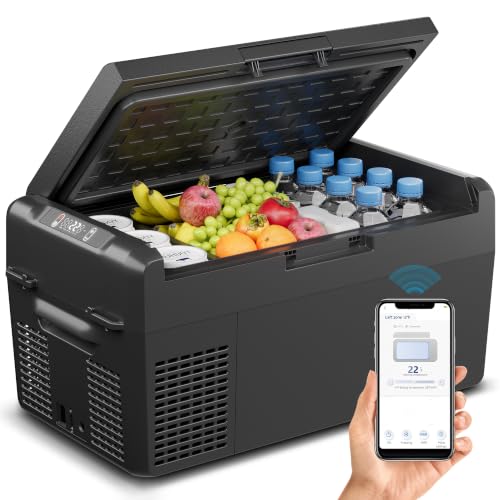

The Feelfunn 21QT is the strongest option in this group for campers who want more room, more convenience, and more advanced control. Its larger capacity makes it better for longer trips or pairs and small families, while the app control and low-noise operation add comfort and flexibility.
Why it stands out: it combines the most storage space here with convenient smart control and strong performance features for serious camping use.
✓ Larger 21QT capacity for more food and drinks
✓ App control with remote temperature and battery monitoring
✓ Fast cooling and deep-freeze capability
✓ Quiet 45 dB operation for overnight comfort
✓ Includes battery protection, AC/DC adapters, and insulation support
✗ Larger size is less convenient for tight vehicle spaces
✗ Better suited to campers who will actually use the extra capacity
✗ Premium feature set may be more than casual weekend users need
Budget Guide: What You Get at Each Tier
Budget tier
At the budget level, you usually get a compact portable fridge with compressor cooling, basic temperature control, and the essential AC/DC power flexibility needed for camping and road travel. This tier is best for solo campers, short trips, and anyone who wants real refrigeration without a large footprint. Expect simpler storage capacity and fewer premium convenience features, but still enough performance for practical outdoor use.
Mid-range tier
Mid-range models tend to improve the overall experience with better portability, quieter operation, more refined controls, and added stability features. This is the sweet spot for many campers because it balances size, usability, and performance. If you camp regularly and want a fridge that feels easier to live with, this tier often offers the best compromise.
Premium tier
Premium portable refrigerators usually offer larger capacity, smarter controls, better convenience features, and stronger suitability for longer trips or more demanding setups. You’re typically paying for a more complete camping experience: more room, better monitoring, and features that reduce hassle when you’re away from home for several days. This tier makes the most sense if your fridge will be used often and must support a bigger load.
Frequently Asked Questions
What size 12V portable refrigerator is best for camping?
It depends on how many people you’re feeding and how long you stay out. Smaller units are usually better for solo campers or short trips, while larger units suit couples, families, or longer stays where you need more food storage.
Do I need a compressor refrigerator for camping?
If you want reliable cooling without ice, yes, compressor models are usually the best choice. They handle warm weather better and can reach true fridge or freezer temperatures, which makes them much more practical for camping.
How important is battery protection in a portable fridge?
Very important. Battery protection helps reduce the chance of draining your vehicle battery when the fridge is running while parked or overnight. It’s one of the most useful safety features to look for.
Can a 12V portable refrigerator run all night while camping?
Many can, but runtime depends on battery capacity, ambient temperature, insulation, and how often the lid is opened. Models with energy-saving modes and battery protection are generally better for overnight use.
Should I choose app control on a camping fridge?
App control is optional, but convenient. It can make temperature adjustments and battery monitoring easier, especially if the fridge is stored in a vehicle or placed somewhere hard to reach.
Pros
- + Compressor cooling for real fridge/freezer performance
- + Dual AC/DC power support for travel and home use
- + Battery protection helps reduce vehicle drain
- + Compact options fit trunks, seats, and truck beds
- + Quiet operation is better for camping and sleeping
Cons
- – Bigger units can be awkward to carry
- – Small capacities may not suit families
- – Some models need careful setup before first use
Frequently asked questions
- What size 12V portable refrigerator is best for camping?
- It depends on how many people you’re feeding and how long you stay out. Smaller units are usually better for solo campers or short trips, while larger units suit couples, families, or longer stays where you need more food storage.
- Do I need a compressor refrigerator for camping?
- If you want reliable cooling without ice, yes, compressor models are usually the best choice. They handle warm weather better and can reach true fridge or freezer temperatures, which makes them much more practical for camping.
- How important is battery protection in a portable fridge?
- Very important. Battery protection helps reduce the chance of draining your vehicle battery when the fridge is running while parked or overnight. It’s one of the most useful safety features to look for.
- Can a 12V portable refrigerator run all night while camping?
- Many can, but runtime depends on battery capacity, ambient temperature, insulation, and how often the lid is opened. Models with energy-saving modes and battery protection are generally better for overnight use.
- Should I choose app control on a camping fridge?
- App control is optional, but convenient. It can make temperature adjustments and battery monitoring easier, especially if the fridge is stored in a vehicle or placed somewhere hard to reach.
Get the Full Outdoor Buyer's Guide
Join our free newsletter — we'll send our latest Outdoor picks, specs and verdicts straight to your inbox.
Free. No spam. Unsubscribe anytime.
Was this review helpful?
Be the first to share your feedback on this review.
Sign in to vote and let us know what you think.
Discussion (0)
No comments yet. Be the first to start the discussion.
Related Reviews

EcoFlow DELTA 2 Portable Power Station Review (2026): Specs, Pros & Cons, and Who It's For
The EcoFlow DELTA 2 has built a reputation around practical, user-friendly design rather than flashy styling. Based on published specs and owner feedback, it is positioned as a portable power station that balances capacity, output, and usability in a form factor many buyers can actually move around

Therm-a-Rest NeoAir NXT Review (2026): Specs, Pros & Cons, and Who It's For
Check Price on Amazon →

Best Alternatives to Yeti in 2026 — Cheaper, Better, or Both?
If you’re shopping for Yeti alternatives for rotomolded coolers , you’re probably trying to solve one of three problems: Yeti’s premium pricing, wanting a lighter cooler that’s easier to carry, or needing similar ice retention without paying for the brand name. The good news is that several competit