


Who this is for: Best for parents and caregivers who need safe, organized cooling for breast milk or medications in home, office, or travel settings.
Check PriceIf you’re trying to figure out how to choose a mini fridge for breast milk and medications, the stakes are higher than a normal dorm-room fridge. You need stable cooling, safe storage, and a size that fits your space without making daily access a hassle. The most common mistake buyers make is choosing a cute compact fridge that looks convenient but lacks the temperature control, lockable storage, or cleaning-friendly design needed for sensitive items.
Related Reviews
This guide breaks down the features that matter most, the red flags to avoid, and the best options worth considering based on published specs, product details, and owner feedback patterns. Because this is a research-based buying guide, it does not claim hands-on testing.
Key Features to Look For
1. Stable, consistent cooling
For breast milk and many medications, consistency matters more than flashy extras. Look for models designed to maintain a steady interior temperature rather than units that cycle wildly or rely on weak cooling. In the product details, the best options emphasize even cooling, temperature monitoring, or active refrigeration rather than basic chill-only storage.
2. The right size for your routine
Capacity should match how often you pump or how many medications you need to keep accessible. A smaller portable unit can work for daily transport, while a compact refrigerator is better for office use, daycare, or a dedicated home storage spot. If the fridge is too large, it wastes space; too small, and you’ll outgrow it fast.
3. Temperature control and visibility
Easy-to-use controls help you keep storage conditions predictable. Features like dial thermostats, exterior controls, digital display, or temperature alarms can make a real difference when you’re storing sensitive items. This is especially important for medications that need a narrow temperature range.
4. Secure storage features
If the fridge will sit in a shared office, daycare, or household common area, a keyed lock is a major plus. It helps protect breast milk, medications, and other personal items from accidental access. A self-closing door can also reduce the chance of temperature loss from repeated opening.
5. Easy cleaning and low maintenance
Milk storage and medication storage both benefit from a unit that’s simple to wipe down. Sealed backs, removable shelves, and automatic defrost can reduce upkeep and make the fridge easier to keep sanitary. That matters when you’re using it every day.
6. Portable power options, if you need mobility
If you plan to use the fridge in a car, at work, or while traveling, power flexibility matters. Some portable cooling bottles can run from a USB source, power bank, car charger, or wall outlet, which makes them far more useful than a standard plug-only unit for on-the-go storage.
7. Safety and compliance details
Look for food-safe materials, hospital-grade cords, ETL or similar safety certification, and design details that support secure everyday use. For breast milk, BPA-free and leak-resistant construction is especially important. For medications, a dependable cord and controlled cooling are equally valuable.
What to Avoid
Unstable or vague temperature performance
A mini fridge that doesn’t clearly explain how it cools or what temperature it holds can be risky for breast milk and medications. Avoid models that only promise “cooling” without offering meaningful control or evidence of consistent internal temperatures.
Cheap dorm-style fridges with no organization
Many budget mini fridges are fine for snacks and drinks but not ideal for sensitive storage. If the interior is hard to organize, has uneven cooling, or lacks a secure door, it may not be the right choice for milk bags or medication bottles.
No lock for shared spaces
If the fridge will be in a workplace, daycare, clinic, or shared home area, skipping a lock is a mistake. It may not seem essential at first, but secure storage becomes much more important when multiple people use the same space.
High-maintenance designs
Units that are difficult to clean, lack removable shelves, or require frequent manual defrosting can become annoying fast. For daily use, convenience matters almost as much as cooling performance.
Portable coolers that rely on ice alone
Ice-based systems can be useful in a pinch, but they depend on prep, refills, and timing. If you need dependable cooling during commuting, travel, or workdays, an active-cooling design is usually the better long-term choice.
Our Top Picks
1. Electric Breast Milk Cooler Bottle with Active Cooling, Portable Breastmilk Storage, 12oz Breast Milk Capacity, No Ice Needed, Mini Fridge Style Chiller, USB Powered, Stainless Steel, TSA Approved

This is the best fit if you need a compact, travel-friendly option for pumping on the move. Its active cooling, USB-powered design, and stainless-steel build make it especially appealing for commuting, workdays, road trips, and air travel. It’s not a replacement for a full-size fridge, but it is a strong portable solution for short-term breast milk storage.
Best for: moms who need a portable, powered cooler instead of a stationary mini fridge.
✓ Active cooling with no ice packs needed
✓ Portable bottle-style design for travel and commuting
✓ USB, car, or wall power compatibility
✓ Leak-resistant, BPA-free, stainless steel construction
✓ TSA approved for travel convenience
✗ Limited capacity compared with a true mini refrigerator
✗ Best for short-term portable storage, not bulk storage
✗ Requires power to maintain active cooling
2. Momcube 19” Breast Milk Refrigerator, 1.7 cu.ft. Capacity, White - MC2


This is the strongest all-around pick for people who want a dedicated breast milk fridge for an office, wellness room, daycare, or home setup. The automatic defrost, internal fan, keyed lock, and compact footprint make it a practical balance of convenience and security. It’s a smart middle-ground option for buyers who want a true refrigerator rather than a portable cooler.
Best for: shared workspaces or home users who want dependable, low-maintenance milk storage.
✓ Automatic defrost for lower-maintenance use
✓ Internal fan for more even cooling
✓ Keyed lock for shared or high-traffic spaces
✓ Compact footprint with useful storage capacity
✓ Hospital-grade cord and sealed back for practical everyday use
✗ Smaller capacity than larger dedicated units
✗ Not as feature-rich as the premium model
✗ Best suited to breast milk storage rather than general-purpose cooling
3. ACCUCOLD Momcube 20” Breast Milk Refrigerator, 2.65 cu.ft. Capacity, ADA Compliant, Medical Refrigerator, Lock, White- ACR45LMC
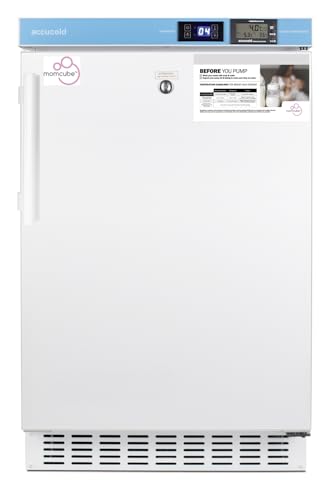

This premium option is the best fit if you need a more serious dedicated refrigerator for breast milk in a clinic, daycare, office, or shared nursing space. The larger capacity, temperature display, alarms, keyed lock, and ADA-friendly dimensions make it the most robust choice in the lineup. It’s the one to consider if you want maximum storage and a more medical-grade feature set.
Best for: professional or high-traffic environments that need secure, stable breast milk refrigeration.
✓ Set for optimum breast milk storage temperature
✓ Larger capacity than the other options here
✓ Temperature alarms and continuous display
✓ Keyed lock and self-closing door for secure use
✓ ADA-compliant sizing and hospital-grade cord
✗ Larger footprint than compact alternatives
✗ Premium build may be more than casual home users need
✗ Better for dedicated storage than portable use
Budget Guide: What You Get at Each Tier
Budget
At the budget level, you’re generally looking at portable, compact cooling rather than a full mini refrigerator. The main advantage is mobility: these products are easier to carry, easier to power in different settings, and better for short-term storage during travel or pumping sessions. You’ll usually give up capacity, long-term storage space, and the kind of temperature monitoring found in larger dedicated units.
Mid-range
Mid-range options usually strike the best balance for everyday users. You can expect a dedicated compact refrigerator with better organization, a lock for shared spaces, automatic defrost, and more reliable temperature control. This tier is often the sweet spot for office use or home users who want a serious solution without going all the way to a premium medical-style unit.
Premium
Premium models are best when storage security, capacity, and temperature control matter most. These fridges often include more advanced monitoring, stronger safety features, and larger interiors. They make the most sense for daycare centers, clinical settings, and workplaces where multiple people may access the fridge and consistency is non-negotiable.
Frequently Asked Questions
What size mini fridge is best for breast milk?
That depends on how much milk you store and where the fridge will live. For daily personal use, a compact unit may be enough. For shared spaces or higher-volume storage, a larger dedicated refrigerator is usually the better choice.
Can I use the same mini fridge for breast milk and medications?
Yes, but only if the temperature requirements are compatible and the items are stored separately and safely. A dedicated, clean, and well-organized fridge is better than mixing everything in a crowded general-use unit.
Do I need a lock on a breast milk mini fridge?
If the fridge will be in a shared office, daycare, clinic, or household common area, a lock is highly recommended. It helps protect personal items and reduces the chance of accidental opening or tampering.
Is a portable breast milk cooler enough, or do I need a full mini fridge?
A portable cooler is great for commuting, travel, and short-term storage. If you need to keep milk or medications chilled for longer periods at one location, a dedicated mini fridge is usually the better solution.
What features matter most for medication storage?
Consistent cooling, easy temperature monitoring, secure storage, and low-maintenance design are the most important features. If medications are temperature-sensitive, avoid basic fridges that don’t clearly support stable internal conditions.
Pros
- + Active cooling portable option for travel
- + Compact dedicated breast milk fridges
- + Lockable storage for shared spaces
- + Automatic defrost and even cooling
- + ADA-friendly premium medical-style model
Cons
- – Portable unit has limited capacity
- – Some options are not ideal for general-purpose use
- – Premium model may be larger than needed
- – Basic fridges can be unstable for sensitive storage
Frequently asked questions
- What size mini fridge is best for breast milk?
- That depends on how much milk you store and where the fridge will live. For daily personal use, a compact unit may be enough. For shared spaces or higher-volume storage, a larger dedicated refrigerator is usually the better choice.
- Can I use the same mini fridge for breast milk and medications?
- Yes, but only if the temperature requirements are compatible and the items are stored separately and safely. A dedicated, clean, and well-organized fridge is better than mixing everything in a crowded general-use unit.
- Do I need a lock on a breast milk mini fridge?
- If the fridge will be in a shared office, daycare, clinic, or household common area, a lock is highly recommended. It helps protect personal items and reduces the chance of accidental opening or tampering.
- Is a portable breast milk cooler enough, or do I need a full mini fridge?
- A portable cooler is great for commuting, travel, and short-term storage. If you need to keep milk or medications chilled for longer periods at one location, a dedicated mini fridge is usually the better solution.
- What features matter most for medication storage?
- Consistent cooling, easy temperature monitoring, secure storage, and low-maintenance design are the most important features. If medications are temperature-sensitive, avoid basic fridges that don’t clearly support stable internal conditions.
Get the Full Health & Fitness Buyer's Guide
Join our free newsletter — we'll send our latest Health & Fitness picks, specs and verdicts straight to your inbox.
Free. No spam. Unsubscribe anytime.
Was this review helpful?
Be the first to share your feedback on this review.
Sign in to vote and let us know what you think.
Discussion (0)
No comments yet. Be the first to start the discussion.
Related Reviews

Polar Ignite 3 Review (2026): Specs, Pros & Cons, and Who It's For
If you’re considering the POLAR Ignite 3 Series Fitness Tracking Smartwatch , the big question is whether its fitness-first feature set is enough to justify the premium positioning. Many buyers want a watch that looks good, tracks workouts accurately, and still feels comfortable enough to wear overn

Garmin Forerunner 965 Review (2026): Specs, Pros & Cons, and Who It's For
The Forerunner 965 is clearly built for athletes who want premium hardware without the bulk of a rugged outdoor watch. The 47mm case gives the watch a substantial screen area, and the titanium bezel helps keep the overall feel lighter than many premium smartwatches in this class.

Withings ScanWatch 2 Review (2026): Specs, Pros & Cons, and Who It's For
The Withings ScanWatch 2 stands out because it looks much more like a traditional watch than a typical smartwatch. That hybrid approach is a major part of its appeal: you get analog hands, a clean face, and a premium stainless steel build, while the watch still hides a capable set of health-tracking