

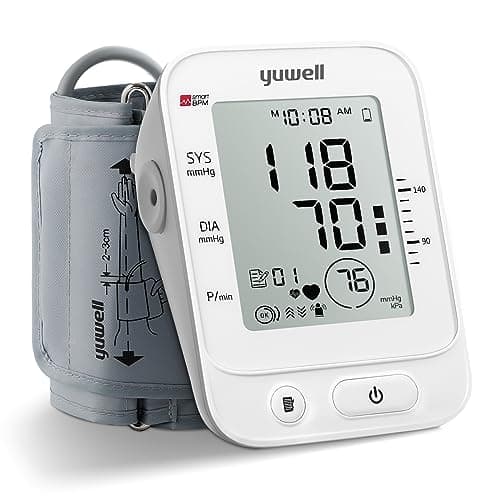
Who this is for: Best for people who want accurate, repeatable home blood pressure readings and need a simple routine they can follow consistently.
Check PriceWhat is How to Measure Blood Pressure Correctly at Home? A Complete 2026 Guide
If you’re trying to learn how to measure blood pressure correctly at home, the biggest challenge is usually not the device—it’s the technique. Small mistakes like the wrong cuff size, talking during the reading, or sitting incorrectly can make numbers look better or worse than they really are. This guide explains the process in plain English, shows what matters most, and highlights a few home monitors that can make accurate tracking easier.
Related Reviews
At home blood pressure monitoring is a simple way to check the force of blood pushing against your artery walls while you’re in a calm, repeatable setting. When done correctly, it can help you and your clinician spot patterns that a one-time office reading might miss, including white-coat effects and day-to-day changes. The key is consistency: same arm, same posture, same time of day, and a validated upper-arm monitor.
This is a research-based explainer built from manufacturer specs, published product details, and owner feedback patterns—not personal hands-on testing. If you want the most useful home reading, the right technique matters just as much as the monitor you buy.
How It Works
Home blood pressure monitors usually use an inflatable upper-arm cuff and an internal sensor that detects tiny pressure changes in the cuff as blood flows through the artery. The cuff briefly inflates to stop blood flow, then slowly deflates while the monitor calculates two numbers: systolic pressure (the top number) and diastolic pressure (the bottom number). Most modern devices also estimate pulse rate and may flag irregular heartbeat patterns.
For everyday use, the process is straightforward: wrap the cuff around your bare upper arm, sit still, press start, and let the machine do the rest. The monitor’s algorithm interprets the signal and displays the result on-screen, often with color codes or voice guidance. Better models also detect movement, cuff issues, or posture problems that can distort the reading.
That’s why “how to measure blood pressure correctly at home” is really a combination of good equipment and good habits. A reliable device helps, but your body position, rest time, and cuff fit are what make the reading meaningful.
Key Benefits & Use Cases
Home monitoring is useful because it gives you more than a single snapshot. It can reveal trends over time, show how your blood pressure responds to medication, and help confirm whether an elevated office reading is persistent or just stress-related.
- Tracking hypertension: Useful for people diagnosed with high blood pressure who need regular monitoring.
- Medication follow-up: Helps show whether treatment is working as expected.
- Doctor visits: Brings a log of readings to appointments for better decision-making.
- Family use: Helpful when multiple adults in the same household want to monitor their health.
- Early awareness: Can help identify unusual trends before they become a bigger issue.
It’s also convenient for people who want a calmer environment than a clinic. Because home readings are repeated under similar conditions, they often give a more realistic picture of your usual blood pressure than a single rushed measurement.
What to Look For When Buying
1. Upper-arm design
Upper-arm monitors are generally the preferred choice for home use because they tend to be more consistent than wrist models when used properly. If you’re learning how to measure blood pressure correctly at home, this is the safest starting point.
2. Correct cuff size
A cuff that is too small or too large can distort results. Look for a model whose cuff range matches your arm circumference, and check whether it’s designed for comfort and easy wrapping.
3. Clear display and easy operation
Large numbers, backlighting, and one-button operation make it easier to use the monitor correctly—especially for seniors or anyone who wants a quick routine without confusion.
4. Memory and tracking features
Built-in storage, multiple user profiles, app syncing, and trend charts can help you spot patterns over time. That matters if you’re comparing morning and evening readings or sharing results with a doctor.
5. Reliability features
Look for irregular heartbeat detection, movement alerts, posture reminders, or validation claims from credible standards. These features don’t replace good technique, but they can reduce avoidable errors.
Top Recommended Products
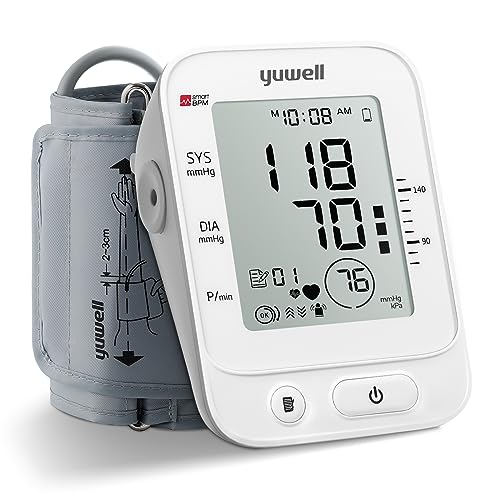 yuwell Blood Pressure Monitor ✓ Prime $29.54


This model stands out for voice guidance, a large cuff, and a simple one-button workflow. The memory storage and posture reminders make it especially friendly for people who want a more guided home-reading experience.
- ✓ Voice broadcast helps guide the measurement process
- ✓ Large cuff range supports more upper-arm sizes
- ✓ Stores 99 readings for basic tracking
- ✓ Includes power adapter and batteries
- ✓ Movement and posture reminders may reduce user error
- ✓ Large display is easy to read
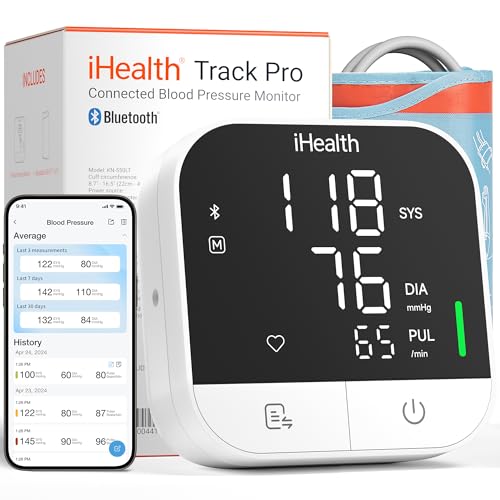 iHealth Track Pro Upper Arm Blood Pressure Monitor ✓ Prime $35.19 10% OFF — Was $39.12


The Track Pro is a strong option if you want app-based history and a very readable display. It combines one-touch use with flexible power options, which is handy for both home and travel.
- ✓ Wide-angle LED screen with color indicators
- ✓ One-button operation keeps use simple
- ✓ App sync supports unlimited readings
- ✓ Stores 120 readings on-device
- ✓ Dual power options add flexibility
- ✓ Built-in sensors help detect movement and cuff issues
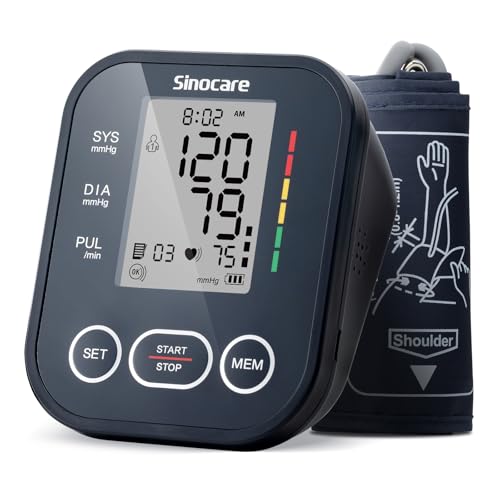 Sinocare Blood Pressure Monitor ✓ Prime $16.99 12% OFF


If you want a budget-friendly monitor for straightforward home readings, this one is easy to understand. It offers dual-user storage, posture detection, and a simple interface without a high price.
- ✓ Very affordable compared with many home monitors
- ✓ One-button operation is beginner-friendly
- ✓ Dual-user mode supports shared household use
- ✓ Color-coded indicators can help interpret results
- ✓ Adjustable cuff fits a wide arm range
- ✓ Type-C charging plus batteries adds flexibility
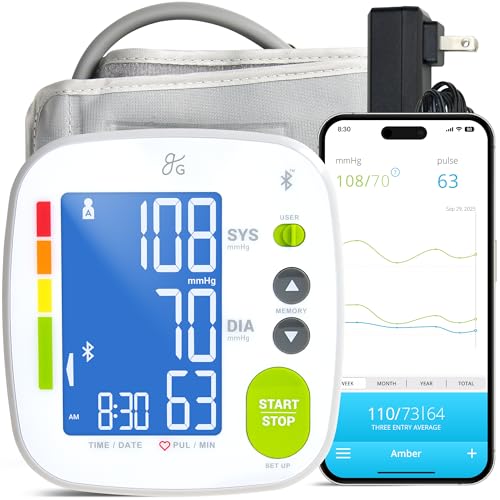 Greater Goods Bluetooth Blood Pressure Monitor ✓ Prime $64.99


This is the most feature-rich option in the group, especially for people who want app syncing and easier trend tracking. It’s a strong fit for routine monitoring, caregivers, and anyone who wants to share data with a clinician.
- ✓ Bluetooth syncing with app-based trend tracking
- ✓ Unlimited readings through the app
- ✓ Built-in memory for offline use
- ✓ Artery alignment guide supports proper cuff placement
- ✓ Backlit display is easy to read
- ✓ Includes case, batteries, and AC adapter
Common Mistakes to Avoid
Even with a good monitor, technique errors can make home blood pressure readings misleading. These are the most common problems to watch for:
- Using the wrong cuff size: A cuff that doesn’t match your arm can skew the result.
- Talking or moving during the reading: Motion can interfere with the measurement.
- Not resting first: Sit quietly for several minutes before taking a reading.
- Crossing your legs: This can affect circulation and raise readings.
- Arm not supported at heart level: Keep your arm relaxed and supported on a table.
- Taking only one reading: Multiple readings are usually more informative than a single number.
- Measuring over clothing: Use a bare upper arm when possible.
If you’re serious about learning how to measure blood pressure correctly at home, repeatability is the goal. Take readings under the same conditions each time, and record them so trends are easier to spot.
Frequently Asked Questions
1. What is the best time of day to measure blood pressure at home?
Most people are advised to measure at the same time each day, often in the morning before medication and again in the evening if tracking trends. Consistency matters more than the exact hour.
2. Should I take blood pressure readings on both arms?
It can be helpful to check both arms at first. After that, use the arm that gives the higher reading unless your clinician tells you otherwise.
3. How many readings should I take each time?
Two readings taken about a minute apart are common, and some people record a third if the first two differ a lot. Follow your doctor’s guidance if you’ve been given a specific routine.
4. Can I measure blood pressure over a shirt?
It’s better to measure on a bare upper arm. Clothing can interfere with cuff placement and affect accuracy.
5. Why are my home readings different from the doctor’s office?
Differences can happen because of stress, posture, cuff size, timing, or measurement technique. Home readings are most useful when you take them consistently and share the log with your clinician.
Pros
- + Upper-arm monitors are generally more consistent
- + Clear displays and one-button operation simplify use
- + Memory and app tracking help spot trends
- + Helpful features can reduce user error
- + Budget and premium options are both available
Cons
- – Wrong cuff size can distort readings
- – Movement and talking can affect accuracy
- – App features add cost on some models
- – Single readings are less useful than trends
Frequently asked questions
- What is the best time of day to measure blood pressure at home?
- Most people are advised to measure at the same time each day, often in the morning before medication and again in the evening if tracking trends. Consistency matters more than the exact hour.
- Should I take blood pressure readings on both arms?
- It can be helpful to check both arms at first. After that, use the arm that gives the higher reading unless your clinician tells you otherwise.
- How many readings should I take each time?
- Two readings taken about a minute apart are common, and some people record a third if the first two differ a lot. Follow your doctor’s guidance if you’ve been given a specific routine.
- Can I measure blood pressure over a shirt?
- It’s better to measure on a bare upper arm. Clothing can interfere with cuff placement and affect accuracy.
- Why are my home readings different from the doctor’s office?
- Differences can happen because of stress, posture, cuff size, timing, or measurement technique. Home readings are most useful when you take them consistently and share the log with your clinician.
Get the Full Health & Fitness Buyer's Guide
Join our free newsletter — we'll send our latest Health & Fitness picks, specs and verdicts straight to your inbox.
Free. No spam. Unsubscribe anytime.
Was this review helpful?
Be the first to share your feedback on this review.
Sign in to vote and let us know what you think.
Discussion (0)
No comments yet. Be the first to start the discussion.
Related Reviews
8 Best Smart Scales in 2026 — Accurate Body Tracking Without the Guesswork
If you’re shopping for the best smart scales 2026 , the challenge is usually the same: too many options, too many health metrics, and not enough clarity on which scale is actually worth buying. Some models are great for simple weight tracking, while others go deeper with body fat, muscle mass, app s
Best Smart Scales Under $50 for Every Budget in 2026: Ranked by Price & Performance
If you’re shopping for the best smart scales under $50 , the good news is that you do not need to spend much to get a reliable bathroom scale. The reality, though, is that ultra-budget models are usually best for simple weight tracking, while better-built options tend to focus on readability, stabil
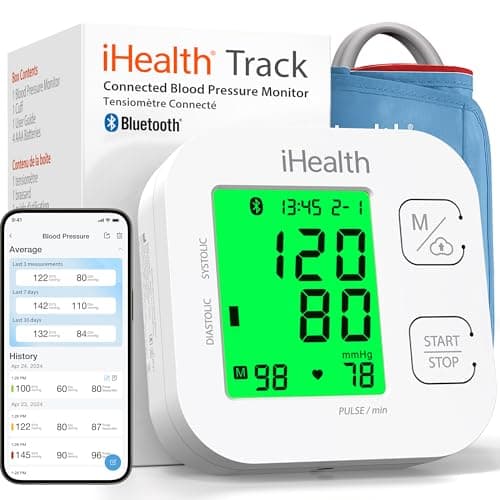
8 Best Home Blood Pressure Monitors in 2026 — Most Accurate, Easy-to-Use Picks for Smarter Tracking
If you’re shopping for the best home blood pressure monitors, the hard part is separating genuinely useful features from marketing noise. You want a device that’s easy to use, readable, and trustworthy enough to help you spot trends at home without frustration. This research-based roundup focuses on