

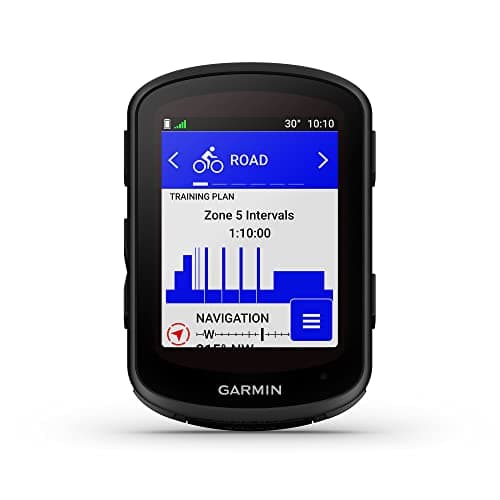
Who this is for: Best for road, gravel, and endurance cyclists who want premium navigation, training insights, and long battery life.
Check PriceGarmin Edge 840 Review (2026): Specs, Pros & Cons, and Who It's For
Key Specifications
| Specification | Details |
|---|---|
| Product | Garmin Edge 840 Solar, Solar-Charging GPS Cycling Computer with Touchscreen and Buttons, Targeted Adaptive Coaching, Advanced Navigation and More |
| Price | $395.00 ✓ Prime |
| Battery life | Up to 26 hours, or 32 hours with solar charging; up to 42 hours in battery saver mode, or 60 hours with solar charging |
| Controls | Touchscreen plus button controls |
| Navigation | Advanced navigation with multi-band GNSS for improved positioning accuracy |
| Training features | Daily suggested workouts, adaptive coaching, ClimbPro, performance tracking |
| Solar benefit | Up to 25 minutes per hour added in battery saver mode during daytime rides in direct sunlight |
Design & Build Quality
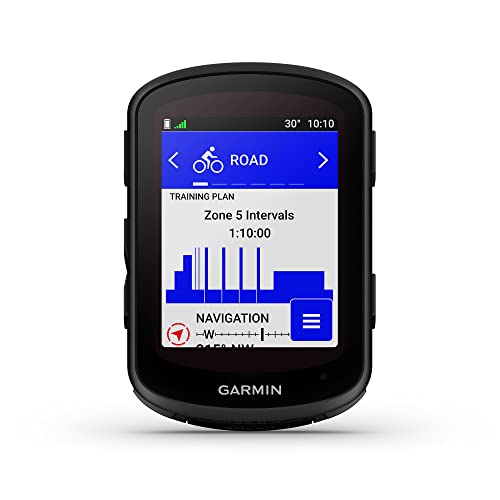
 The Garmin Edge 840 is designed around a practical idea: give cyclists a compact computer that works well in real riding conditions, not just on paper. The combination of a touchscreen and physical buttons is one of its biggest design advantages, because it gives you flexibility in wet weather, with gloves, or when you want quick menu navigation without relying entirely on taps.
Owner feedback and published reviews consistently point to the 840’s strong balance of size and usability. It is small enough to keep the cockpit clean, yet large enough to display maps, workout prompts, and climb data without feeling cramped. That makes it especially appealing to riders who want a premium device without jumping to a larger, heavier unit.
The solar version adds another layer of appeal for endurance riders. While solar charging should be seen as a battery extender rather than a full replacement for charging, it can help reduce range anxiety on long rides and multi-day events.
✓ Pros
- Touchscreen and button controls give you flexibility in all conditions
- Compact form factor fits road, gravel, and endurance setups well
- Solar charging can extend battery life during daytime rides
- Premium, ride-focused design feels purpose-built for serious cyclists
✗ Cons
- The screen is smaller than larger Garmin units, so map viewing is less spacious
- Solar benefits depend heavily on sun exposure and ride conditions
- More complex than basic bike computers for casual riders
The Garmin Edge 840 is designed around a practical idea: give cyclists a compact computer that works well in real riding conditions, not just on paper. The combination of a touchscreen and physical buttons is one of its biggest design advantages, because it gives you flexibility in wet weather, with gloves, or when you want quick menu navigation without relying entirely on taps.
Owner feedback and published reviews consistently point to the 840’s strong balance of size and usability. It is small enough to keep the cockpit clean, yet large enough to display maps, workout prompts, and climb data without feeling cramped. That makes it especially appealing to riders who want a premium device without jumping to a larger, heavier unit.
The solar version adds another layer of appeal for endurance riders. While solar charging should be seen as a battery extender rather than a full replacement for charging, it can help reduce range anxiety on long rides and multi-day events.
✓ Pros
- Touchscreen and button controls give you flexibility in all conditions
- Compact form factor fits road, gravel, and endurance setups well
- Solar charging can extend battery life during daytime rides
- Premium, ride-focused design feels purpose-built for serious cyclists
✗ Cons
- The screen is smaller than larger Garmin units, so map viewing is less spacious
- Solar benefits depend heavily on sun exposure and ride conditions
- More complex than basic bike computers for casual riders
Related Reviews
Performance & Features

 This is where the Edge 840 earns its reputation. Garmin’s published feature set shows a device built for riders who care about structured training, route reliability, and ride-day decision making. The multi-band GNSS support is especially important for riders who spend time in dense tree cover, mountains, or urban environments where GPS accuracy can suffer.
The training side is equally strong. The Edge 840 can surface daily suggested workouts and training prompts, and it can adapt coaching based on your training load and recovery when paired with a compatible power meter and heart rate monitor. For cyclists who follow structured plans, that makes it more than a navigation tool — it becomes a training partner.
ClimbPro is another standout. Instead of only showing you a generic elevation profile, it helps you see remaining ascent and grade so you can pace climbs more intelligently. That’s useful on long rides, hilly routes, and race-day efforts where effort management matters.
Published owner feedback generally praises the Edge 840 for fast routing, reliable navigation, and a feature set that feels genuinely advanced without being gimmicky. The learning curve is real, though. Riders who want simple speed, distance, and time may find it overkill.
Key performance takeaways:
- Multi-band GNSS improves positioning accuracy in difficult terrain
- Touch and button controls make on-bike operation more reliable
- Training prompts and adaptive coaching are valuable for structured cyclists
- ClimbPro adds real utility on hilly routes
- Battery life is strong, especially with solar support
✓ Pros
- Excellent navigation and route guidance
- Multi-band GNSS improves accuracy in challenging environments
- Adaptive coaching and workout prompts support serious training
- ClimbPro is genuinely useful for climbing and pacing
- Long battery life is a major plus for endurance riding
✗ Cons
- Advanced features can feel overwhelming to casual cyclists
- Best training functions depend on compatible sensors
- Solar charging helps, but it is not a magic solution for all-day power needs
This is where the Edge 840 earns its reputation. Garmin’s published feature set shows a device built for riders who care about structured training, route reliability, and ride-day decision making. The multi-band GNSS support is especially important for riders who spend time in dense tree cover, mountains, or urban environments where GPS accuracy can suffer.
The training side is equally strong. The Edge 840 can surface daily suggested workouts and training prompts, and it can adapt coaching based on your training load and recovery when paired with a compatible power meter and heart rate monitor. For cyclists who follow structured plans, that makes it more than a navigation tool — it becomes a training partner.
ClimbPro is another standout. Instead of only showing you a generic elevation profile, it helps you see remaining ascent and grade so you can pace climbs more intelligently. That’s useful on long rides, hilly routes, and race-day efforts where effort management matters.
Published owner feedback generally praises the Edge 840 for fast routing, reliable navigation, and a feature set that feels genuinely advanced without being gimmicky. The learning curve is real, though. Riders who want simple speed, distance, and time may find it overkill.
Key performance takeaways:
- Multi-band GNSS improves positioning accuracy in difficult terrain
- Touch and button controls make on-bike operation more reliable
- Training prompts and adaptive coaching are valuable for structured cyclists
- ClimbPro adds real utility on hilly routes
- Battery life is strong, especially with solar support
✓ Pros
- Excellent navigation and route guidance
- Multi-band GNSS improves accuracy in challenging environments
- Adaptive coaching and workout prompts support serious training
- ClimbPro is genuinely useful for climbing and pacing
- Long battery life is a major plus for endurance riding
✗ Cons
- Advanced features can feel overwhelming to casual cyclists
- Best training functions depend on compatible sensors
- Solar charging helps, but it is not a magic solution for all-day power needs
Value for Money
At $395, the Garmin Edge 840 Solar sits in the premium midrange of cycling computers. It is not cheap, but the value proposition is strong if you will actually use the navigation, training, and battery features. In other words, the price makes more sense for riders who treat their bike computer as a training and route-planning tool rather than just a speedometer. Compared with simpler bike computers, the Edge 840 is expensive. But compared with other premium Garmin options, it can be a smarter buy because it delivers many of the same core strengths in a smaller package. The inclusion of solar charging also helps justify the price for endurance riders who want extra battery margin. From a research-based perspective, the value is best when: - You ride long distances - You rely on navigation often - You train with structured workouts - You want premium features without moving to a larger unit If you only need basic ride stats, the Edge 840 is more computer than you need. ✓ Pros - Strong feature set for the price - Solar charging adds practical battery value - Premium navigation and training tools justify the cost for serious riders - Good long-term buy for cyclists who will use its advanced features ✗ Cons - Expensive for casual riders - Value drops if you only need basic ride tracking - Some premium features require additional sensors or Garmin ecosystem useWho Should Buy This
The Garmin Edge 840 is best for cyclists who want a serious all-around cycling computer with excellent navigation, strong battery life, and advanced training support. It is especially well suited to road riders, gravel riders, endurance cyclists, and anyone who regularly follows structured workouts. You should strongly consider it if you: - Want both touchscreen and button controls - Need reliable navigation in unfamiliar areas - Care about climb data and route planning - Ride long enough that battery life matters - Use a power meter and heart rate monitor This is also a strong choice for riders who want a premium Garmin without going larger or more expensive than necessary.Who Should Look Elsewhere
You may want to skip the Edge 840 if you are a casual cyclist who only needs basic metrics like speed, distance, and ride time. It can also be more feature-rich than necessary if you rarely navigate with maps or train with structured workouts. Look elsewhere if you: - Want the simplest possible bike computer - Don’t need advanced mapping or coaching - Prefer a larger display for easier map reading - Are on a tighter budget - Ride mostly short, uncomplicated routesFinal Verdict
The Garmin Edge 840 is one of the strongest premium cycling computers you can buy in 2026 if you want a compact device that does nearly everything well. Research from specs, published reviews, and owner feedback suggests it delivers excellent navigation, strong battery life, and genuinely useful training features. If you are a serious cyclist, endurance rider, or performance-focused weekend rider, this is an easy buy. If you only need basic ride data, it is probably more computer than you need.Frequently Asked Questions
Is the Garmin Edge 840 worth it in 2026?
Yes, for riders who want advanced navigation, training tools, and long battery life. It is especially worth it if you use structured workouts or ride long distances.
Does the Garmin Edge 840 have touchscreen and buttons?
Yes. One of its biggest strengths is the combination of touchscreen and physical button controls, which improves usability in different riding conditions.
How long does the Garmin Edge 840 battery last?
Garmin lists up to 26 hours of battery life, or up to 32 hours with solar charging. In battery saver mode, it can reach up to 42 hours, or up to 60 hours with solar charging.
Is the Garmin Edge 840 good for mountain biking?
It can work well for mountain biking, especially for riders who want navigation and performance tracking. However, Garmin also offers the Edge MTB as a more purpose-built alternative for trail riders.
Who is the Garmin Edge 840 best for?
It is best for road, gravel, and endurance cyclists who want premium navigation, training insights, and a compact bike computer with strong battery life.
Pros
- + Touchscreen and button controls
- + Excellent navigation and route guidance
- + Multi-band GNSS improves accuracy
- + Adaptive coaching and workout prompts
- + Long battery life with solar support
Cons
- – Smaller screen than larger Garmin units
- – Solar benefits depend on sunlight
- – Advanced features can overwhelm casual riders
- – Best training tools need extra sensors
Frequently asked questions
- Is the Garmin Edge 840 worth it in 2026?
- Yes, for riders who want advanced navigation, training tools, and long battery life. It is especially worth it if you use structured workouts or ride long distances.
- Does the Garmin Edge 840 have touchscreen and buttons?
- Yes. One of its biggest strengths is the combination of touchscreen and physical button controls, which improves usability in different riding conditions.
- How long does the Garmin Edge 840 battery last?
- Garmin lists up to 26 hours of battery life, or up to 32 hours with solar charging. In battery saver mode, it can reach up to 42 hours, or up to 60 hours with solar charging.
- Is the Garmin Edge 840 good for mountain biking?
- It can work well for mountain biking, especially for riders who want navigation and performance tracking. However, Garmin also offers the Edge MTB as a more purpose-built alternative for trail riders.
- Who is the Garmin Edge 840 best for?
- It is best for road, gravel, and endurance cyclists who want premium navigation, training insights, and a compact bike computer with strong battery life.
Score breakdown
- value
- 8.7
- usability
- 9.2
- durability
- 9.0
- performance
- 9.5
- buyerFeedback
- 9.0
Get the Full Outdoor Buyer's Guide
Join our free newsletter — we'll send our latest Outdoor picks, specs and verdicts straight to your inbox.
Free. No spam. Unsubscribe anytime.
Was this review helpful?
Be the first to share your feedback on this review.
Sign in to vote and let us know what you think.
Discussion (0)
No comments yet. Be the first to start the discussion.
Related Reviews
2 Best Gravel Bike Tires in 2026 — Fast Racing Speed vs. Budget Off-Road Grip
If you’re trying to find the best gravel bike tires 2026 , the challenge is usually the same: you want faster rolling on mixed terrain without giving up traction, comfort, or flat protection. The two picks below were selected from research-based comparisons of specs, published product details, and o
Bike Tire Puncture Resistance Test Review (2026): Specs, Pros & Cons, and Who It's For
Check Price on Amazon →
What is Bike Groupset Hierarchy Explained? A Complete 2026 Guide
If you’ve ever looked at Shimano or SRAM specs and felt lost, you’re not alone. “Bike groupset hierarchy explained” usually means figuring out which parts matter, what the tiers mean, and whether a cheaper setup will actually fit your riding. This guide breaks down the hierarchy in plain English so